These notes were written by the person who submitted this item. Appraiser.AI has not verified them, and the AI's identification and estimate may rely on them.
AI Estimated Value
Not an official valuation
$150 - $250
AI estimate as of August 8, 2025 · verify with a professional before acting
AI-Generated · Verify before acting
Everything on this page is generated by AI for informational purposes only. AI can make mistakes — the AI may misidentify items or misattribute them (artist, maker, brand, designer, origin, era). This is not an official valuation and should not be used for insurance, sale, tax, estate, legal, or lending purposes — or any decision requiring a certified appraisal. It is not an authoritative claim about any person, brand, or rights holder — do not share or rely on it as a factual statement about a third party. Always consult qualified professionals before making financial decisions.
This analysis also relies on unverified notes provided by the user, which may be incomplete or inaccurate and could affect the result.
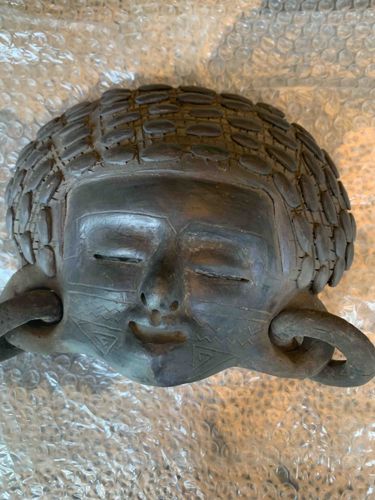
This appears to be a decorative ceramic head or mask, crafted from terra cotta with a dark, possibly bronze-like patinated finish. The item depicts a stylized human face with closed eyes, a broad nose, and a slight, serene smile. Its most striking features are the elaborate ear ornaments, which appear to be large, circular loops integrated into the design, and the highly textured, segmented 'hair' or headwear, resembling individual dreadlocks or braids, arranged closely across the top and sides of the head. The surface of the face is adorned with incised geometric patterns, likely triangles and lines, on the cheeks and chin, suggesting cultural or tribal influences. The material, identified as terra cotta, indicates a clay-based construction, which has been fired and then given a dark surface treatment, possibly a glaze or pigment, to achieve its current appearance. The overall condition shows a consistent, somewhat matte finish across the surface. There are no obvious signs of significant damage such as chips or cracks visible in the provided image, but the integrated 'earrings' suggest delicate areas that might be prone to damage. The craftsmanship appears to be of good quality, with attention to detail in the intricate 'hair' and facial features. The style suggests a possible influence from ancient or indigenous cultures, potentially Mesoamerican or African, given the facial features, ear ornaments, and geometric patterns. Without further markings or context, precise manufacturing details like a maker's mark or specific age are difficult to ascertain, but it likely dates from the 20th or 21st century.
AI Appraisal Report
Upon visual examination of the images provided, this Terra Cotta Sculptural Head presents as a compelling decorative artwork from the 20th or 21st century. The piece is crafted from terra cotta with a dark, patinated finish, giving it an aged, bronze-like appearance. The condition appears to be good, with no evident chips, cracks, or significant surface degradation. The craftsmanship is notable, particularly in the detailed, textured rendering of the hair or headwear and the stylized, serene facial features with incised geometric patterns.
Its value is primarily derived from its decorative and aesthetic appeal. The style shows influences from ancient cultures, possibly Mesoamerican or African, which is a popular decorative motif. However, it is most likely a contemporary studio piece rather than an authentic historical artifact. Current market conditions for similar, well-executed, unsigned studio pottery and ceramic sculptures place its value in a modest range. Comparable decorative busts of this size and quality, without attribution to a known artist or studio, typically sell in the secondary market.
The primary factor limiting its value is the lack of provenance or a maker's mark. Without these, it is impossible to attribute the work to a specific artist or culture, treating it as a decorative object rather than a fine art piece. For full authentication and to rule out any possibility of it being a genuine antique, a physical examination would be essential to inspect for maker's marks, assess the true nature of the material and finish, and look for signs of age not visible in photographs. Thermoluminescence (TL) testing could date the firing of the clay if an ancient origin were suspected, though this is highly unlikely based on the style.