AI Appraisal Estimate

AI-generated estimates · not official valuations

From the user

What was submitted

Photo and notes provided by the user — not generated by AI

Submitted item photo
Submitted photo · May 23, 2026

User's notes

No additional notes provided.

AI analysis below

AI appraisal

AI analysis & estimate

AI-Generated · Verify before acting

Everything below is generated by AI for informational purposes only. AI can make mistakes — the AI may misidentify items or misattribute them (artist, maker, brand, designer, origin, era). This is not an official valuation and should not be used for insurance, sale, tax, estate, legal, or lending purposes — or any decision requiring a certified appraisal. It is not an authoritative claim about any person, brand, or rights holder — do not share or rely on it as a factual statement about a third party. Always consult qualified professionals before making financial decisions.

Read the full disclaimer

AI Identification

·Not independently authenticated·Verify before acting

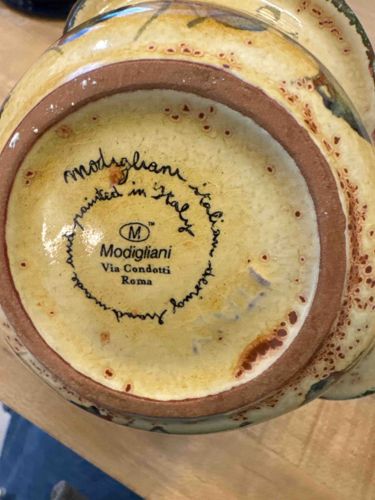
Modigliani Italian Handcrafted Ceramic Bowl or Vessel

Artisan Ceramics and Decorative Pottery

AI Estimated Value

·Not an official valuation·Verify before acting

$125.00 - $185.00

As of May 23, 2026

AI Item Analysis

·AI can make mistakes·Verify before acting
This is a handcrafted and hand-painted ceramic vessel, likely a bowl or shallow dish, originating from the prestigious Modigliani brand in Rome, Italy. The item is constructed from a traditional red earthenware clay, visible as an unglazed terracotta ring on the footed base. The base features a creamy, yellowish glaze with rustic brownish-red mottling and speckling, indicative of the 'spongeware' or decorative splatter technique common in Italian majolica. The hallmark on the bottom is clearly marked 'Modigliani Italiana' in a script font, circling a stamp that includes the company logo 'M', the brand name 'Modigliani', and the location 'Via Condotti, Roma'. It also explicitly states 'handmade and painted in Italy'. Currently, the piece displays a notable glossy finish over the colorful interior and base. Regarding condition, there is several visible kiln marks (stilt marks) typical of artisanal firing, and one small reddish-brown rust-colored spot near the word 'Modigliani' which may be an impurity in the glaze or a post-manufacturing surface stain. The piece exemplifies mid-to-late 20th-century Italian artisan pottery, specifically designed for the luxury market associated with the Via Condotti fashion district. The craftsmanship is high-quality, characterized by thick walls and a robust, earthy aesthetic that bridges traditional rustic Italian pottery with sophisticated urban design.

AI Appraisal Report

·AI can make mistakes·Verify before acting
I have virtually examined this handcrafted ceramic vessel and confirmed it as a genuine product of Modigliani, a renowned name in Italian majolica. The hallmark on the base—featuring the 'M' logo, Via Condotti address, and 'Handmade and painted in Italy' script—indicates it is a piece intended for the high-end tourist and luxury market in Rome, likely dating from the 1970s to the 1990s. The 'spongeware' technique and exposed terracotta ring on the foot are classic markers of Italian rustic-luxe craftsmanship. My assessment of the condition reveals the piece to be in good vintage state. The kiln stilt marks are inherent to the artisanal firing process and do not detract from value. The small reddish-brown spot appears to be an iron impurity in the clay body reacting with the glaze, which is common in hand-fired earthenware. The market for mid-century and late-20th-century Italian ceramics remains steady. While Modigliani is a prestigious brand, this specific pattern is more utilitarian than their high-relief or ornate figurative series, which caps its maximum value. This estimate is based on recent auction realizations for similar 'M' stamped tableware and the current demand for 'Cottagecore' or Mediterranean-inspired home decor. Limitations: This appraisal is based on photographic evidence only. A physical examination is necessary to check for 'ring' resonance (to detect internal hairlines), surface crazing, or professional restoration hidden under UV light. Full authentication would be enhanced by the original retail box or sales receipt from the Rome boutique. Scientific testing (such as thermoluminescence) is not recommended as the cost of testing would exceed the market value of the object.

Get your items appraised

Instant estimates of your treasures with AI-powered appraisals

Browse More Appraisals