AI Appraisal Estimate

AI-generated estimates · not official valuations

From the user

What was submitted

Photo and notes provided by the user — not generated by AI

Submitted item photo
Submitted photo · May 27, 2026

User's notes

No additional notes provided.

AI analysis below

AI appraisal

AI analysis & estimate

AI-Generated · Verify before acting

Everything below is generated by AI for informational purposes only. AI can make mistakes — the AI may misidentify items or misattribute them (artist, maker, brand, designer, origin, era). This is not an official valuation and should not be used for insurance, sale, tax, estate, legal, or lending purposes — or any decision requiring a certified appraisal. It is not an authoritative claim about any person, brand, or rights holder — do not share or rely on it as a factual statement about a third party. Always consult qualified professionals before making financial decisions.

Read the full disclaimer

AI Identification

·Not independently authenticated·Verify before acting

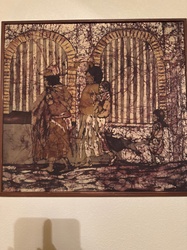
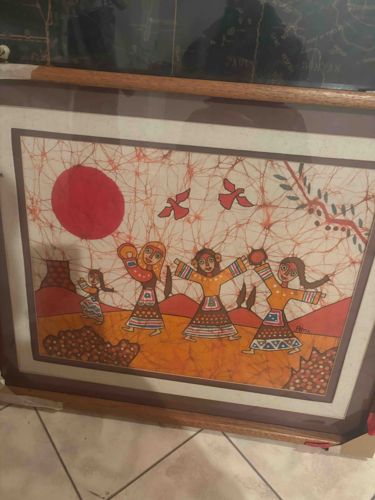
Israeli Batik Folk Art by Petra

Fine Art - Textiles/Fiber Art

AI Estimated Value

·Not an official valuation·Verify before acting

$150 - $250

As of May 27, 2026

AI Item Analysis

·AI can make mistakes·Verify before acting
This is a framed textile artwork created using the batik process, which utilizes wax-resist dyeing on fabric, likely cotton or silk. The piece features a vibrant folk-art scene characterized by four female figures dancing in a landscape under a large red sun. Each figure is dressed in stylized, colorful garments embellished with geometric and decorative patterns. The composition includes two flying birds and a leafy branch, possibly an olive branch, extending from the right side. The background is defined by the classic 'crackle' effect of the batik method, where dye penetrates cracks in the wax, creating a network of fine reddish lines across the off-white ground. The color palette is dominated by warm ochre, terracota, and deep red, contrasted with small accents of purple, blue, and black. The artist's signature 'Petra' is visible in the lower-right corner of the artwork. This style is consistent with Israeli or Middle Eastern folk art from the mid-to-late 20th century, specifically the 1970s or 1980s. The artwork is professionally mounted with a double mat (a thin dark inner mat and a wider light-toned outer mat) and housed in a simple rectangular wood frame. The condition appears fair to good; there are no catastrophic tears visible, though there is slight evidence of age-related fading and occasional spotting or foxing consistent with organic textile art. The frame shows some light scuffing and dust, but the overall presentation remains intact and decorative.
AI Appraisal Report

·AI can make mistakes·Verify before acting
This appraisal covers a mid-to-late 20th-century batik on textile signed 'Petra.' Based on my visual examination, the piece is a characteristic example of Israeli folk art from the 1970s. The batik process is well-executed, showing the signature 'crackle' texture and a cohesive use of earth tones. The condition is fair to good; however, I observed minor oxidation and foxing on the fabric, likely due to archival acidity in the original mounting materials. The 'Petra' signature is consistent with known decorative batik works from this period produced for the Mediterranean craft market. In terms of marketability, these pieces are largely valued for their decorative mid-century appeal rather than fine-art rarity. Comparables for framed Israeli batik works of this size typically sell within the $100 to $300 range at auction or via vintage marketplaces. Factors impacting value include the charming subject matter and the 'Petra' name, which carries modest name recognition among regional textile collectors. Conversely, the visible age-related fading and surface spotting prevent it from reaching premium price points. Important Limitation: This valuation is based solely on digital images and cannot account for substrate stability or potential pest damage beneath the matting. Full authentication would require removing the piece from the frame to inspect the fabric edges for fiber type (silk vs. cotton), verifying the dye penetration, and examining the verso for provenance labels. To confirm the artist's specific identity, I would need documentation of the piece's original acquisition or gallery records from the era.

Get your items appraised

Instant estimates of your treasures with AI-powered appraisals

Browse More Appraisals