AI estimate as of September 27, 2025 · verify with a professional before acting
AI-Generated · Verify before acting
Everything on this page is generated by AI for informational purposes only. AI can make mistakes — the AI may misidentify items or misattribute them (artist, maker, brand, designer, origin, era). This is not an official valuation and should not be used for insurance, sale, tax, estate, legal, or lending purposes — or any decision requiring a certified appraisal. It is not an authoritative claim about any person, brand, or rights holder — do not share or rely on it as a factual statement about a third party. Always consult qualified professionals before making financial decisions.
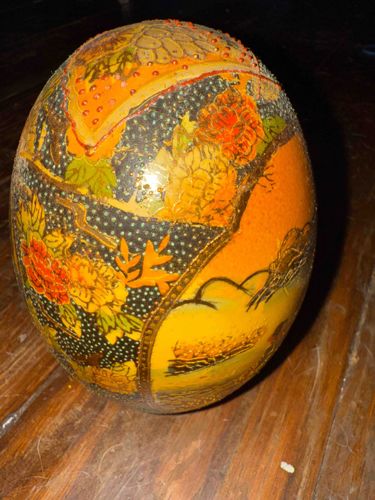
The item is a decorated ostrich egg, likely hollowed out and preserved. Its overall shape is ovoid, consistent with a large bird egg. The primary colors evident are vibrant orange, deep green, mustard yellow, and black, accented with smaller dots of white and red. The surface of the egg is entirely covered with intricate decoration, featuring a patchwork-like design composed of distinct sections. One dominant pattern features large, stylized floral motifs, possibly peonies or chrysanthemums, in shades of orange, red, and yellow, set against a dark, possibly black, background speckled with numerous small white dots. Another section exhibits a landscape-style painting in warmer yellows and oranges, depicting what appears to be rolling hills or mountains with some abstract elements. A third visible pattern, particularly near the top, shows a more textured, possibly raised or embossed design in lighter yellow/tan tones, depicting repeating organic or scale-like shapes. The various decorated sections are outlined and separated by narrow borders, some of which appear to have small, raised red beads or dots applied, giving a tactile quality to the surface. The craftsmanship suggests a hand-painted and embellished piece. There is visible wear and a layer of dust or grime across the surface, particularly noticeable in the darker areas and crevices, indicating age and previous handling or display. Some of the painted details show slight fading or minor abrasions, consistent with an older decorative object. The luster suggests a varnished or lacquered finish, but the exact material of the decorative elements beyond paint is not definitively clear from the image. The style leans towards an ethnic or folk art aesthetic, possibly Asian-inspired due to the floral patterns.
AI Appraisal Report
Based on my visual examination of the provided image, this decorated ostrich egg presents as a charming, likely hand-painted folk art piece. The condition shows visible wear, including dust/grime accumulation, some minor abrasions to the painted details, and potential fading, all consistent with an object of some age that has been handled or displayed over time. The craftsmanship, particularly the intricate floral motifs and patterned sections, suggests a dedicated artistic effort. While the style has an Asian or ethnic folk art aesthetic, without further context, pinpointing an exact origin or artist is impossible from images alone.
Market conditions for decorated ostrich eggs are somewhat niche, typically appealing to collectors of ethnographic art, decorative arts, or unique curios. Comparables often vary widely based on the artist's renown, origin, and the complexity/quality of the decoration. Pieces attributed to recognized artists or specific cultural traditions can fetch higher prices. This piece, while aesthetically pleasing, appears to be an anonymous work, which generally places it in a more accessible price bracket. Demand for such items is steady but not exceptionally high, making rarity a factor only if it could be linked to a specific, unusual cultural practice or artist. The current condition, with noticeable wear and grime, does slightly impact its value, as prospective buyers often prefer items in pristine states or with clear restoration potential.
Limitations in authenticity verification are significant when relying solely on images. Full authentication would require in-person examination to assess the egg's integrity, the nature of the decorative materials (paint pigments, lacquers, applied embellishments), and to potentially identify any artist signatures or regional markings obscured by wear. Provenance documentation, such as acquisition records or historical photos, would be crucial for establishing origin, age, and any significant cultural context. Scientific testing could verify material composition and age, especially if there were claims of ancient origin. Without these, it remains a decorative object of general interest rather than a piece tied to a specific historical narrative or artist.