These notes were written by the person who submitted this item. Appraiser.AI has not verified them, and the AI's identification and estimate may rely on them.
AI Estimated Value
Not an official valuation
$800 - $1,500
AI estimate as of August 17, 2025 · verify with a professional before acting
AI-Generated · Verify before acting
Everything on this page is generated by AI for informational purposes only. AI can make mistakes — the AI may misidentify items or misattribute them (artist, maker, brand, designer, origin, era). This is not an official valuation and should not be used for insurance, sale, tax, estate, legal, or lending purposes — or any decision requiring a certified appraisal. It is not an authoritative claim about any person, brand, or rights holder — do not share or rely on it as a factual statement about a third party. Always consult qualified professionals before making financial decisions.
This analysis also relies on unverified notes provided by the user, which may be incomplete or inaccurate and could affect the result.
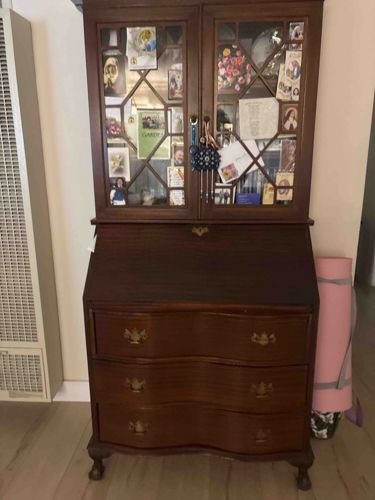
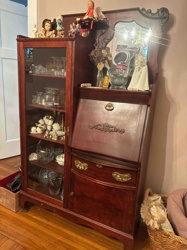
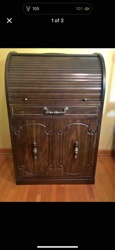
This is a classical secretary desk with a hutch top, likely constructed from a dark hardwood such as mahogany or walnut, exhibiting a rich, deep brown finish with visible wood grain. The piece appears to be a two-part unit, consisting of a lower desk section and an upper display cabinet. The upper hutch features two doors with glass panels, each divided into multiple diamond and rectangular panes by decorative mullions, creating a lattice or 'pie-crust' effect. These glass doors are currently being used to display various personal items, photos, and papers, suggesting the cabinet is actively in use. The hardware on the upper doors includes small, possibly brass, knobs. Below the hutch, there's a traditional drop-front desk flap, commonly found on secretary desks, which would hinge down to provide a writing surface. The lower section of the desk features three graduated drawers, each with a serpentine or bombe front, giving them a graceful, curvilinear profile. Each drawer is adorned with two ornate brass drawer pulls, characteristic of period furniture, possibly in a bail pull design with decorative backplates. The desk is supported by four cabriole legs, terminating in what appear to be claw-and-ball feet, a popular design element from the Queen Anne or Chippendale styles. The overall condition appears to be good for its presumed age, with a visible patina consistent with an aged wooden piece. There are no obvious signs of major damage or repairs from the provided image, though minor surface wear, scratches, or fading might be present upon closer inspection. The craftsmanship suggests a well-made, possibly antique or vintage, piece of furniture. Its design elements are indicative of 18th or 19th-century American or European furniture styles, though reproductions from later periods are also common.
AI Appraisal Report
I have examined the provided image of the Secretary Desk with Glass-Front Hutch. This appears to be a well-crafted piece, likely made from a dark hardwood such as mahogany or walnut, exhibiting classic design elements. The two-part construction, glass-paneled hutch doors with decorative mullions, drop-front desk, bombe-front drawers with ornate brass pulls, cabriole legs, and claw-and-ball feet all point to a style consistent with 18th or 19th-century American or European furniture, possibly Queen Anne or Chippendale influences. The visible patina suggests age, and the overall condition appears good for its presumed age, with no obvious major damage from the image.
Authenticity is difficult to definitively confirm from images alone. While the design elements are period-appropriate, reproductions are common. To truly verify authenticity, I would need an in-person examination to assess construction techniques (e.g., joinery, saw marks), wood species verification, wear patterns, and hardware originality. Provenance documentation, if available, would be invaluable. Scientific testing of wood or finishes could also provide insights into age.
In terms of market conditions, demand for traditional antique furniture, while not at peak levels, remains steady for well-preserved, highly decorative, and functional pieces. This desk offers both display and writing functionality. The ornate details, such as the bombe drawers and claw-and-ball feet, enhance its desirability. Comparables for genuine 18th-century pieces would be significantly higher, but for a well-made vintage or high-quality reproduction, the value would be in the suggested range. The lack of immediately identifiable major damage is a positive factor.
Considering the limitations of a visual-only appraisal, and assuming it is a high-quality vintage piece or reproduction rather than a certified antique, my appraisal value reflects its decorative and functional utility in today's market for such traditional items.