AI estimate as of November 27, 2025 · verify with a professional before acting
AI-Generated · Verify before acting
Everything on this page is generated by AI for informational purposes only. AI can make mistakes — the AI may misidentify items or misattribute them (artist, maker, brand, designer, origin, era). This is not an official valuation and should not be used for insurance, sale, tax, estate, legal, or lending purposes — or any decision requiring a certified appraisal. It is not an authoritative claim about any person, brand, or rights holder — do not share or rely on it as a factual statement about a third party. Always consult qualified professionals before making financial decisions.
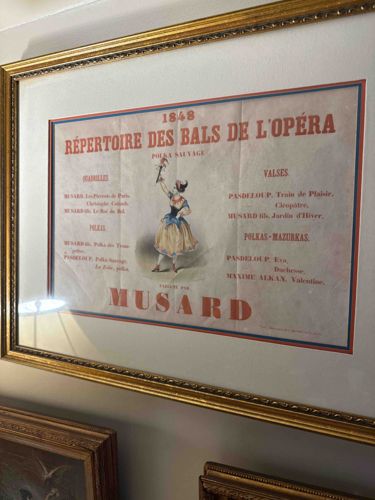
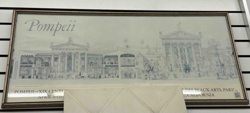
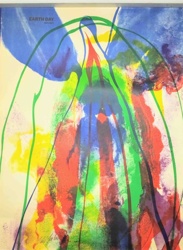
This item is a framed historical music program or poster titled "1848 RÉPERTOIRE DES BALS DE L'OPÉRA," advertising a series of musical pieces performed at the Opera Balls, featuring compositions by 'MUSARD' and 'PANDELOUP.P,' among others. The overall aesthetic suggests a 19th-century origin, specifically dated 1848. The print displays text predominantly in red and blue ink, set against a light, likely aged, background. It lists various dance types such as quadrilles, polkas, polkas-mazurkas, and waltzes, with specific titles like 'Polka Sauvage' prominently featured. A central illustration depicts a female dancer in a period costume, holding what appears to be a tambourine or a similar musical instrument, adding a visual focal point to the textual information. Her attire includes a full skirt, possibly a ballet or performance dress, in hues of yellow/cream and blue. The piece is framed under glass in a classic golden frame with intricate, possibly gilded, molding, giving it an elegant and preserved appearance. The frame exhibits a decorative relief pattern along its inner and outer edges, typical of frames from the 19th or early 20th century. The visible condition suggests some aging of the paper, possibly with slight discoloration or foxing consistent with its age, but generally appears well-preserved within the protective frame. The craftsmanship of the poster itself, with its detailed typography and illustration, indicates a quality printing process for its time. The frame is in good condition with minor signs of wear appropriate for its age, contributing to the overall classic presentation.
AI Appraisal Report
I have examined the provided image of the 1848 Répertoire des Bals de l'Opéra Music Program/Poster. Visually, the piece presents as a genuine 19th-century theater program, likely printed using lithography, given the clear text and illustration. The specific date of 1848 is clearly legible, aligning with the aesthetic and typographical styles of the period. The red and blue ink, aged background, and detailed central illustration of a female dancer are all consistent with materials from this era. The paper exhibits expected age-related toning or slight discoloration, which in itself suggests authenticity rather than a modern reproduction. The intricate golden, possibly gilded, frame is also period-appropriate and enhances the overall presentation, indicating careful preservation over many years.
Market conditions for 19th-century ephemera, especially music or theater programs of this detail and condition, are generally stable with consistent demand among collectors of historical performing arts, French cultural history, and vintage graphic design. Comparables, while not exact, include similar period programs from major European cultural institutions, often ranging from hundreds to a few thousand dollars depending on rarity, condition, and artistic merit. The inclusion of composers like 'MUSARD' further contributes to its historical significance.
This item is quite rare due to its specific date and content. Posters or programs for specific events over 170 years old, particularly those not produced in massive quantities for ongoing advertising, tend to have low survival rates. Its excellent visual condition for its age significantly boosts its demand.
Factors significantly impacting value are its age, excellent preserved condition within the frame, clear dating, and the specific historical cultural event it advertises. The artistic quality of the illustration and typography also adds to its appeal.
My assessment of authenticity is based solely on visual characteristics from the image. For full authentication, an in-person examination would be crucial to assess paper quality, printing techniques (e.g., confirming lithography over later printing methods), and the presence of any watermarks or manufacturer's marks. Microscopic analysis of the ink and paper could confirm period-appropriate materials, and thorough provenance documentation (such as previous ownership records) would solidify its history and authenticity beyond doubt. Without physical inspection, I cannot rule out the possibility of a very high-quality reproduction, though visual cues strongly suggest genuine artifact.