AI estimate as of September 27, 2025 · verify with a professional before acting
AI-Generated · Verify before acting
Everything on this page is generated by AI for informational purposes only. AI can make mistakes — the AI may misidentify items or misattribute them (artist, maker, brand, designer, origin, era). This is not an official valuation and should not be used for insurance, sale, tax, estate, legal, or lending purposes — or any decision requiring a certified appraisal. It is not an authoritative claim about any person, brand, or rights holder — do not share or rely on it as a factual statement about a third party. Always consult qualified professionals before making financial decisions.
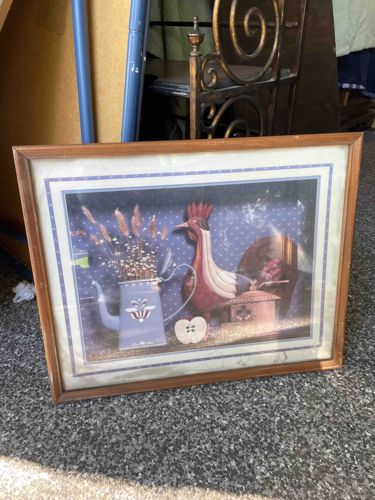
This is a framed decorative print, likely a poster or lithograph, featuring a folk art or country rustic aesthetic. The main subject of the print is a stylized rooster with a prominent red comb and wattles, and a segmented body rendered in shades of red, white, and a muted bluish-gray. To the left of the rooster is a light blue watering can adorned with a white folk art motif consisting of a central floral-like design with stylized leaves. Protruding from the watering can is a bouquet of dried grasses or wheat-like stems, possibly with small white flowers. In the foreground, below the rooster, there's a small, light-colored wooden birdhouse or similar structure with cut-out heart shapes. A white, stylized apple shape with small dark dots (resembling stitches or seeds) is placed in front of the watering can. The background is a dark blue with a subtle white polka-dot or small star pattern. The entire print is surrounded by a triple border: an inner thin white line, followed by a light blue and white striped band (resembling ticking fabric), and an outer thin blue line. The print is housed in a simple rectangular wooden frame with a medium natural wood tone, exhibiting some visible wear, scuffs, and possibly minor discoloration, particularly along the edges and corners, suggesting age and handling. The overall condition indicates a used item, with some dust and minor surface imperfections visible on the glass or print surface. The art style suggests a late 20th-century to early 21st-century production, aiming for a homely, farmhouse-chic decor. The craftsmanship of the frame is basic, and the print itself appears to be a mass-produced decorative item.
AI Appraisal Report
I have examined the provided image of the Framed Folk Art Style Rooster and Watering Can Print. My assessment suggests this item is a decorative wall art piece, likely a mass-produced poster or lithograph, dating from the late 20th to early 21st century, designed to evoke a farmhouse or country chic aesthetic.
**Condition and Authenticity:** The print appears to be in fair to good condition, with some visible dust or minor surface imperfections, possibly on the glass or print itself. The wooden frame exhibits noticeable wear, scuffs, and potential discoloration, consistent with a used item. Authenticity, in this context, refers more to its origin as a decorative mass-produced print rather than a unique artwork. Based on visual cues, it is consistent with a commercially manufactured item, not an original folk art painting. Without physical inspection, I cannot confirm if the print is a lithograph, giclée, or another printing method, nor can I assess any fading or damage hidden by glare.
**Market Conditions and Comparables:** The market for mass-produced decorative prints, particularly those with a folk art or country aesthetic, is generally quite broad but also highly saturated. New items of this nature can often be found at home goods stores for $20-$60. Used examples typically fetch significantly less. Comparable used items on secondary markets (e.g., online marketplaces, thrift stores, estate sales) usually range from $10-$40.
**Demand and Rarity:** There is a consistent but not robust demand for country-style decor. This specific item does not appear to possess any features that would make it rare; it is a common decorative style. Its mass-produced nature diminishes any rarity. The simple, non-artisan frame further confirms its status as a decorative piece rather than a valuable art print.
**Factors Impacting Value:** The primary factors impacting value are its mass-produced nature, the commonality of the style, and the visible wear on the frame. It lacks the artistic merit, unique provenance, or limited edition status that would command a higher price. Its value is purely decorative.
**Limitations in Authenticity Verification:** Without a physical examination, I cannot ascertain the exact print quality, assess for hidden damage to the print itself (such as water damage or significant fading), or confirm the materials used in its construction. In-person examination would allow for a closer inspection of the print medium, frame integrity, and a more precise assessment of overall condition. Provenance documentation would not likely be relevant for an item of this type, as it is not a unique artist's work. Scientific testing would be unnecessary.