AI Appraisal Estimate

AI-generated estimates · not official valuations

From the user

What was submitted

Photo and notes provided by the user — not generated by AI

Submitted item photo
Submitted photo · June 12, 2026

User's notes

No additional notes provided.

AI analysis below

AI appraisal

AI analysis & estimate

AI-Generated · Verify before acting

Everything below is generated by AI for informational purposes only. AI can make mistakes — the AI may misidentify items or misattribute them (artist, maker, brand, designer, origin, era). This is not an official valuation and should not be used for insurance, sale, tax, estate, legal, or lending purposes — or any decision requiring a certified appraisal. It is not an authoritative claim about any person, brand, or rights holder — do not share or rely on it as a factual statement about a third party. Always consult qualified professionals before making financial decisions.

Read the full disclaimer

AI Identification

·Not independently authenticated·Verify before acting

Antique/Vintage Wooden Dining Table

Furniture

AI Estimated Value

·Not an official valuation·Verify before acting

$450 - $700

As of June 12, 2026

AI Item Analysis

·AI can make mistakes·Verify before acting
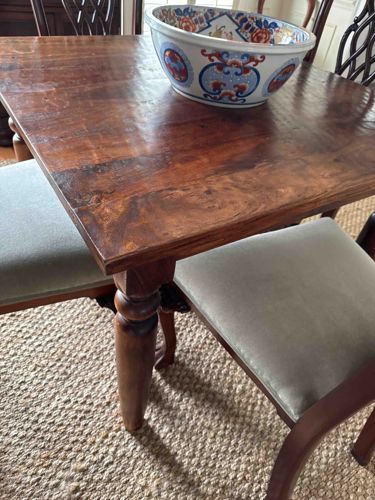
This appears to be an antique or vintage dining table constructed primarily of a hardwood, likely a fruitwood or possibly mahogany, given the rich, warm reddish-brown tones visible in the polished finish. The tabletop features a plank construction with visible wood grain patterns, suggesting solid wood rather than veneer. The finish exhibits a moderate to high sheen, indicating a varnish or lacquer, and shows a noticeable patina consistent with age and use, including minor scratching, scuffs, and possibly some unevenness in the finish, particularly towards the center of the table where there might be some lighter areas or subtle texture variation. The table is supported by at least one substantial, turned and baluster-shaped leg, which suggests a pedestal or gate-leg design, though the full base is not visible. The turning work on the leg is well-executed, indicative of quality craftsmanship. The table's edge is solid, without elaborate carving but well-finished. The overall style points to a traditional design, possibly late 19th to early 20th century. The table is paired with what appear to be upholstered chairs with light gray fabric, suggesting it is currently in use as a dining set. No specific maker's marks or signatures are discernible from the image. The presence of a decorative ceramic bowl on the table provides a sense of scale, suggesting a moderate-sized dining table.
AI Appraisal Report

·AI can make mistakes·Verify before acting
Upon visual examination of the provided imagery, I have assessed this wooden dining table. The piece presents as a well-crafted, traditional-style table, likely dating from the late 19th to early 20th century. My initial assessment of the wood, based on the grain and warm reddish-brown hue, suggests a quality hardwood such as mahogany or a fruitwood. The plank-style top and the skillfully turned baluster leg are indicative of quality craftsmanship from that era. The condition appears to be good for its age, displaying an expected patina that includes minor scuffs, scratches, and some wear to the finish, which is consistent with its history and use. These are not signs of abuse but rather of a life well-lived, and do not significantly detract from the value for a non-pristine antique. The current market for traditional brown furniture has softened, but well-made, solid wood pieces like this retain steady interest. Comparable pedestal or gate-leg tables from this period, in similar condition but without a confirmed maker, typically sell in the $450 to $700 range at auction or in secondary marketplaces. Its moderate size makes it versatile for modern homes, which supports demand. The primary factor limiting a higher valuation is the absence of a discernible maker's mark or provenance. Without physical inspection, I cannot confirm the wood species, rule out veneer on unseen surfaces, or check for structural repairs. Full authentication would require in-person examination to search for maker's marks, analyze joinery techniques, and potentially use wood analysis to confirm the materials and origin.

Get your items appraised

Instant estimates of your treasures with AI-powered appraisals

Browse More Appraisals