AI estimate as of August 20, 2025 · verify with a professional before acting
AI-Generated · Verify before acting
Everything on this page is generated by AI for informational purposes only. AI can make mistakes — the AI may misidentify items or misattribute them (artist, maker, brand, designer, origin, era). This is not an official valuation and should not be used for insurance, sale, tax, estate, legal, or lending purposes — or any decision requiring a certified appraisal. It is not an authoritative claim about any person, brand, or rights holder — do not share or rely on it as a factual statement about a third party. Always consult qualified professionals before making financial decisions.
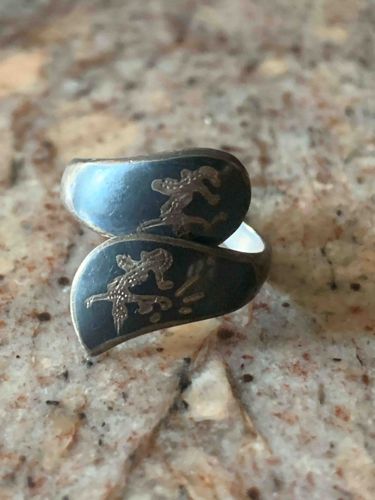
This is a vintage or antique ring, likely crafted from silver or a similar white metal, given its visible patina and somewhat muted luster. The design features a wrap-around or bypass style, with two distinct, somewhat ovate, flattened facets forming the top of the ring. Each of these facets is adorned with what appears to be an engraved or possibly etched mythical creature, specifically a dragon-like figure, rendered in a darker, contrasting material against a gray or dark blue background. This dark inlay could be niello work, enamel, or a similar technique used to create a strong visual contrast with the metallic body of the ring. The creatures are depicted in a dynamic pose, possibly chasing a pearl or cloud symbol, which is a common motif in East Asian art. The metal shows signs of age, including tarnishing and minor surface scratches, contributing to an attractive patina that enhances its antique appeal. The edges of the metallic surfaces appear slightly worn but still retain their shape. The craftsmanship suggests a handmade or semi-handmade origin, with attention paid to the detailed depiction of the mythical beasts. Given the stylistic elements, it likely dates from the early to mid-20th century, possibly of Asian (e.g., Chinese or Japanese) origin, where dragon motifs are culturally significant. There are no discernible maker's marks or stamps visible in the provided image. The overall condition suggests regular wear but no significant damage or repairs are apparent; the piece has age-appropriate wear and retains its structural integrity. The inner band is not visible, so its finish and any potential markings remain unknown.
AI Appraisal Report
I have examined the provided image of the Dragon Motif Inlaid Bypass Ring. Based on visual assessment, the ring appears to be a vintage or antique piece, likely crafted from silver or a similar white metal, exhibiting an attractive patina consistent with age. The design features two distinct ovate facets, each inlaid with a dragon-like figure in a contrasting dark material, possibly niello or enamel, against a darker background. This technique creates a strong visual impact. The presence of dragon motifs, particularly in a dynamic pose, strongly suggests an East Asian origin, likely Chinese or Japanese, dating from the early to mid-20th century. The craftsmanship appears hand-finished, indicating attention to detail.
The condition appears good for its age, with age-appropriate wear including tarnishing and minor surface scratches, adding to its antique appeal rather than detracting from it. No significant damage or repairs are evident. The structural integrity seems intact.
Market conditions for vintage ethnic jewelry with compelling design are generally stable. While not high-demand, pieces with unique aesthetic appeal like this often find appreciative buyers. Comparables would include other vintage silver rings with cultural motifs or niello work. Rarity is moderate; while Dragon motif rings exist, this specific style and presumed age makes it less common than mass-produced contemporary pieces.
Factors impacting value positively include its appealing design, apparent age, and probable East Asian origin. Negative factors include the lack of visible maker's marks, which makes definitive attribution difficult, and the material likely being silver rather than a more precious metal. Value is also limited by the fact that the inlay technique cannot be definitively determined (niello vs. enamel vs. other) without physical inspection.
Crucially, this appraisal is limited by the visual examination of an image. Full authentication would require in-person examination to verify metal composition, the inlay technique, and any hidden maker's marks or stamps on the inner band. Provenance documentation, though unlikely for such a piece, would further enhance its value and authenticity. Scientific testing, like XRF analysis for metal composition, would provide definitive material confirmation.