AI estimate as of August 21, 2025 · verify with a professional before acting
AI-Generated · Verify before acting
Everything on this page is generated by AI for informational purposes only. AI can make mistakes — the AI may misidentify items or misattribute them (artist, maker, brand, designer, origin, era). This is not an official valuation and should not be used for insurance, sale, tax, estate, legal, or lending purposes — or any decision requiring a certified appraisal. It is not an authoritative claim about any person, brand, or rights holder — do not share or rely on it as a factual statement about a third party. Always consult qualified professionals before making financial decisions.
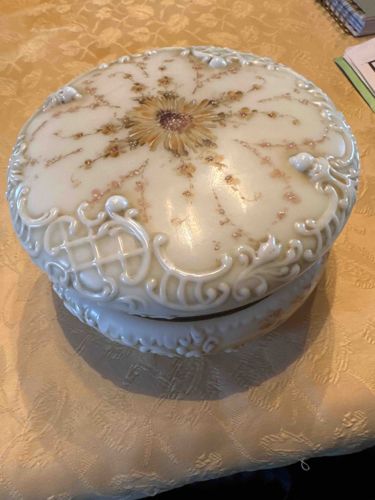
This is a round, lidded box, likely made of milk glass or a similar opaque white ceramic, possibly opalware. The primary color is an off-white or cream, giving it a soft, aged appearance. The lid features a central, hand-painted floral motif, prominently displaying a large, multi-petalled flower, possibly a chrysanthemum or similar bloom, rendered in shades of yellow, gold, and light brown with a reddish-brown or purple center. Radiating outwards from this central flower are delicate, hand-painted vine-like patterns with small clusters and individual dots in coordinated earthy tones, including lighter browns, golds, and faint pink or rose hues, suggesting delicate floral or beaded accents. The painting exhibits a fine level of detail and control, indicative of skilled craftsmanship. The edge of the lid, as well as the upper and lower portions of the box body, are adorned with intricate raised relief ornamentation. This relief work consists of scrolling acanthus leaves, C-scrolls, and lattice-like patterns, adding significant textural and visual interest. The raised elements are also in the same off-white/cream color as the base material, creating a monochromatic yet highly decorative effect. The overall style suggests an early 20th-century aesthetic, possibly Art Nouveau or Victorian revival, given the floral and elaborate scrollwork. The quality of the relief molding appears high, with crisp details. No obvious chips, cracks, or repairs are visible, and the paintwork seems largely intact, suggesting good preservation for its age. The item functions as a decorative container, often used for trinkets, jewelry, or powder. The craftsmanship points to a manufactured piece with hand-finished decorative elements.
AI Appraisal Report
Based on my visual examination of the provided image, this Decorated Milk Glass or Opalware Covered Box presents as a well-preserved piece. The off-white/cream opaque material, likely milk glass or opalware, shows no obvious chips, cracks, or significant abrasions. The hand-painted floral motif, particularly the central multi-petalled flower and delicate vine patterns, appears largely intact with good color retention, suggesting careful handling over its lifespan. The intricate raised relief ornamentation, featuring scrolling acanthus leaves, C-scrolls, and lattice-like patterns on both the lid and body, exhibits crisp details, indicating quality molding. Without physical inspection, I cannot definitively confirm authenticity beyond what appears to be a consistent aesthetic from the early 20th century, possibly Art Nouveau or Victorian revival, a period known for such decorative motifs and manufacturing techniques. The craftsmanship suggests a commercial piece with hand-finished elements. Market conditions for decorative milk glass or opalware are relatively stable, with demand for smaller, well-decorated pieces like this. Comparables would include similar covered boxes from known American or European manufacturers of opaque glass. While not exceedingly rare, a piece in this condition with attractive hand-painting and detailed relief work holds more appeal than plain examples. Factors positively impacting value include its excellent apparent condition, attractive aesthetic, and functional size as a trinket or powder box. Conversely, its mass-produced nature, even with hand-applied decoration, prevents it from reaching higher values reserved for unique or artist-signed pieces. The primary limitation in authenticity verification from images alone is the inability to assess the material's true properties (e.g., specific gravity for opalware vs. milk glass), the exact method of decoration application, or the presence of any subtle repairs or restoration not visible in the photo. An in-person examination would allow for tactile assessment, detailed inspection under magnification, and potentially UV light testing to reveal repairs or overpainting. Provenance documentation, if available, would further enhance authentication and value certainty. Given these considerations, I appraise this item at the following value.