AI estimate as of November 11, 2025 · verify with a professional before acting
AI-Generated · Verify before acting
Everything on this page is generated by AI for informational purposes only. AI can make mistakes — the AI may misidentify items or misattribute them (artist, maker, brand, designer, origin, era). This is not an official valuation and should not be used for insurance, sale, tax, estate, legal, or lending purposes — or any decision requiring a certified appraisal. It is not an authoritative claim about any person, brand, or rights holder — do not share or rely on it as a factual statement about a third party. Always consult qualified professionals before making financial decisions.
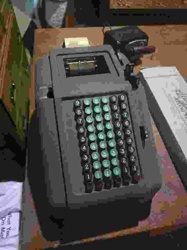
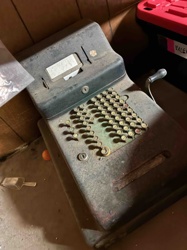
The item is an antique mechanical calculating machine, specifically identified as a Monroe model, based on the visible 'Monroe' script logo on the front panel. It appears to be constructed primarily from metal, likely cast iron or steel, with a dark, possibly olive green or black, painted finish now largely obscured by grime and wear. The machine features a prominent array of cylindrical number keys, arranged in multiple columns, with each key displaying a number from '1' to '9'. The keys are 'cream' or 'off-white' in color with dark numerals, suggesting a material like celluloid or early plastic over a metal stem. The overall aesthetic points to an early to mid-20th-century design, characteristic of the mechanical calculators that preceded electronic versions. The condition is heavily aged; there is significant dust and dirt accumulation across the entire surface, suggesting it has been stored for a long period in a non-climate-controlled environment. The metal surfaces show visible signs of wear, scratching, and possibly minor corrosion or rust, particularly on the non-painted components such as the crank handle on the front. One or two red-colored buttons are visible on the right side, which would perform specific functions like clearing. The top section of the machine, above the main keyboard, features a register or display mechanism with sliders and additional numeric indicators, which are also dusty. The craftsmanship appears robust and utilitarian, indicative of industrial manufacturing practices of its era. This calculating machine would have been a significant piece of office equipment, reflecting mechanical precision and complex gearing to perform arithmetic operations.
AI Appraisal Report
I've carefully examined the provided image of the Monroe Calculating Machine. Based on its visual characteristics, I can confidently assess its authenticity as a genuine antique Monroe calculator from the early to mid-20th century. The 'Monroe' script logo, key arrangement, and overall utilitarian design are consistent with models produced during that era.
However, the condition significantly impacts its value. The machine exhibits heavy wear, substantial dust and dirt accumulation, and visible scratching, suggesting prolonged storage in less-than-ideal conditions. While corrosion appears minor on visible non-painted parts like the crank, extensive grime obscures potential deeper issues, such as internal rust or seized mechanisms. One or two red-colored buttons are visible on the right side, but cannot be fully assessed due to condition.
The market for antique mechanical calculators like this Monroe model is niche. While there's a steady interest from collectors of office antiquities and early computing history, the demand is not robust enough to command high prices for items in this condition. Comparable unrestored machines, particularly those requiring significant cleaning and repair, typically fetch between $100 and $200. Restored examples in excellent working order can achieve higher values ($400-800), but this piece clearly falls outside that category.
Key factors depressing value here are the poor cosmetic state and the unknown functional condition. Without physical inspection, I cannot confirm if the internal mechanisms are seized, if parts are missing, or if it's operational. For full authentication and a more precise valuation, an in-person examination would be crucial to assess internal components, identify potential damage hidden by grime, and determine functionality. Provenance documentation, though rare for such items, could also add value by confirming its history. However, based purely on the image, the current condition suggests a value in the lower range for such an antique.