These notes were written by the person who submitted this item. Appraiser.AI has not verified them, and the AI's identification and estimate may rely on them.
AI Estimated Value
Not an official valuation
$75-150
AI estimate as of September 5, 2025 · verify with a professional before acting
AI-Generated · Verify before acting
Everything on this page is generated by AI for informational purposes only. AI can make mistakes — the AI may misidentify items or misattribute them (artist, maker, brand, designer, origin, era). This is not an official valuation and should not be used for insurance, sale, tax, estate, legal, or lending purposes — or any decision requiring a certified appraisal. It is not an authoritative claim about any person, brand, or rights holder — do not share or rely on it as a factual statement about a third party. Always consult qualified professionals before making financial decisions.
This analysis also relies on unverified notes provided by the user, which may be incomplete or inaccurate and could affect the result.
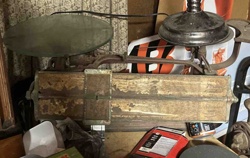
This appears to be the lid of an antique carpenter's tool chest, consistent with the provided context of an 1800s piece. The lid is rectangular and constructed from multiple planks of a dark, weathered wood, likely pine or oak, judging by the grain patterns and historical use in such chests. The wood exhibits significant age and use, characterized by a deep, uneven patina ranging from dark brown to grayish-black, indicative of oil, grime, and environmental exposure over a long period. Visible physical characteristics include prominent wood grain, some areas of rough sawing or planing marks, and what appears to be a raised central panel or cleat construction, suggesting a method of preventing warping and strengthening the lid. The corners are reinforced with hammered, possibly hand-forged, iron or steel plates, secured with visible nails or rivets. These corner protectors show considerable oxidation and pitting, consistent with age and exposure. There are no clear manufacturer's marks or signatures visible from this angle. The overall condition shows heavy wear, including scratches, dents, and possibly some splintering along the edges, testifying to its functional history. The craftsmanship appears robust and utilitarian, designed for durability in a working environment rather than aesthetic refinement. The presence of what look like boot soles next to it provides a sense of scale, suggesting the lid is of a substantial size, likely fitting a chest large enough to hold a variety of hand tools.
AI Appraisal Report
Upon examination of the provided image, I have assessed the item presented: the lid of what is described as an 1800s carpenter's tool chest. The visual evidence strongly supports this identification. The construction, featuring plank wood with a deep, aged patina, and reinforced corners with hammered, oxidized metal hardware, is consistent with utilitarian chests of that era. The significant wear, including scratches, dents, and grime, speaks to a long and authentic history of use, which collectors of primitive or utilitarian antiques often appreciate. The item is not a complete chest, but a single component. This dramatically impacts its value. While a complete, well-preserved chest from the 19th century can command several hundred to over a thousand dollars, a lid alone has a much smaller market. Its primary value is decorative, perhaps as a wall hanging or for a restoration project where a period-appropriate lid is needed. The current market for Americana and antique tools has a steady but niche demand for such items. Considering it is only a part of the original object and lacking the complete chest, its value is significantly diminished. Based on sales of similar fragments and decorative primitives, I place the fair market value in its current, as-is condition. Limitations: This appraisal is based solely on images. Full authentication would require in-person inspection to confirm the wood type, age, and construction methods, as well as to check for any hidden maker's marks. Without provenance or physical examination, I cannot definitively confirm its 1800s origin, though it is visually consistent.