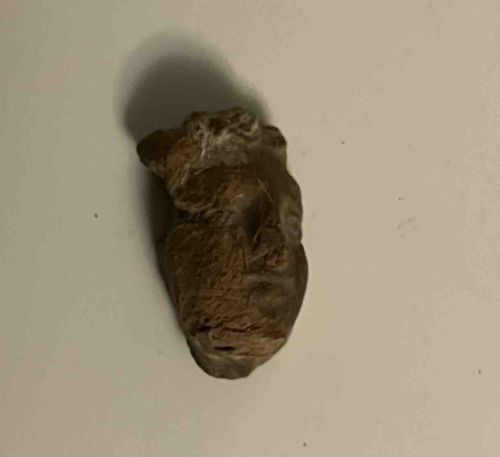
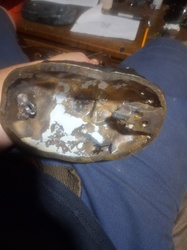
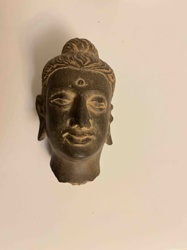
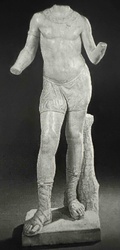
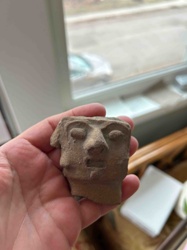
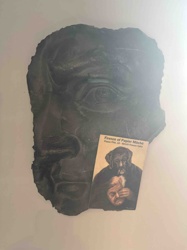
Fragmented sculpture head, Approximately 1 in x 1/2 in
These notes were written by the person who submitted this item. Appraiser.AI has not verified them, and the AI's identification and estimate may rely on them.
AI Estimated Value
Not an official valuation
$50-150
AI estimate as of July 16, 2025 · verify with a professional before acting
AI-Generated · Verify before acting
Everything on this page is generated by AI for informational purposes only. AI can make mistakes — the AI may misidentify items or misattribute them (artist, maker, brand, designer, origin, era). This is not an official valuation and should not be used for insurance, sale, tax, estate, legal, or lending purposes — or any decision requiring a certified appraisal. It is not an authoritative claim about any person, brand, or rights holder — do not share or rely on it as a factual statement about a third party. Always consult qualified professionals before making financial decisions.
This analysis also relies on unverified notes provided by the user, which may be incomplete or inaccurate and could affect the result.
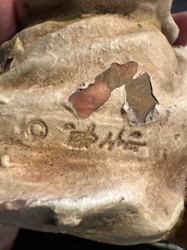
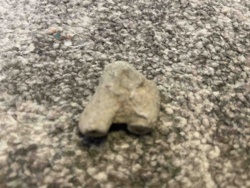
This appears to be a fragmented sculptural head, likely crafted from a terrestrial material such as clay, terracotta, or a similar composite. The primary color is a muted brown, suggesting the natural color of the material or the accumulation of dirt and age. Its approximate dimensions are 1 inch by 0.5 inches, making it a miniature, possibly even a portion of a larger, more detailed figurine or statuette. The visible characteristics of the head suggest a human or humanoid form, with discernible features resembling an eye socket, a cheekbone, and a possible chin or jawline. The surface exhibits a rough, somewhat eroded texture, which could be indicative of significant age, environmental exposure, or simply the coarse nature of the material and construction method. There are clear signs of fragmentation, with jagged edges where the head has been broken off from a larger body or structure. Fine lines or cracks are visible on the surface, contributing to an aged patina. No specific maker's marks, signatures, or discernible manufacturing stamps are visible in the provided imagery. The rudimentary appearance and wear suggest it could be an archaeological artifact or a very old folk art piece. The craftsmanship, while not highly refined in its current state, indicates a deliberate attempt to sculpt a recognizable form, possibly hinting at an ancient or pre-modern stylistic period. The pronounced wear and missing elements suggest an item that has endured considerable time and physical stress.
AI Appraisal Report
I have carefully examined the provided image and details concerning this fragmented sculptural head. My assessment of its condition is that it is severely compromised, being only a small fragment (approximately 1 inch by 0.5 inches) of what was once a larger piece. The rough, eroded texture, fine lines, and jagged edges are consistent with significant age and environmental exposure, suggesting an archaeological artifact or a very old folk art piece. The visible features—eye socket, cheekbone, and chin/jawline—do indicate a human or humanoid form, though the craftsmanship appears rudimentary.
Authenticity, based solely on imagery, is difficult to definitively confirm. While its appearance suggests antiquity, without direct physical examination, I cannot rule out the possibility of a modern reproduction or even a natural rock formation that coincidentally resembles a head.
Market conditions for such fragmentary pieces, especially without clear provenance or established cultural attribution, are generally low. Comparables would range widely depending on confirmed origin (e.g., ancient Roman vs. 19th-century folk art). Demand for generic, unidentifiable fragments is limited, primarily appealing to niche collectors of curiosities or educational institutions if its authenticity and origin could be verified.
Rarity is hard to establish without knowing its context; many ancient cultures produced countless such small figures. The primary factor significantly impacting value is the lack of verifiable authenticity and provenance. If this piece were definitively identified as an artifact from a recognized ancient civilization (e.g., Roman, Egyptian, Pre-Columbian), its value would increase substantially.
For full authentication, an in-person examination is crucial to assess the material properties, signs of tooling, and patination under magnification. Scientific testing, such as thermoluminescence dating (for ceramic materials), spectrographic analysis of the material, or petrographic analysis, would be necessary to determine its age and composition. Crucially, any provenance documentation — such as records of excavation, prior ownership, or exhibition history — would be paramount in establishing its authenticity and historical significance.