AI estimate as of October 3, 2025 · verify with a professional before acting
AI-Generated · Verify before acting
Everything on this page is generated by AI for informational purposes only. AI can make mistakes — the AI may misidentify items or misattribute them (artist, maker, brand, designer, origin, era). This is not an official valuation and should not be used for insurance, sale, tax, estate, legal, or lending purposes — or any decision requiring a certified appraisal. It is not an authoritative claim about any person, brand, or rights holder — do not share or rely on it as a factual statement about a third party. Always consult qualified professionals before making financial decisions.
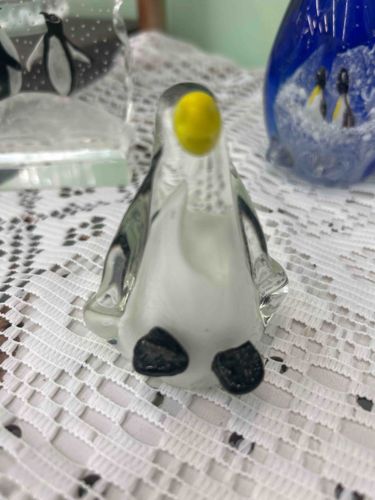
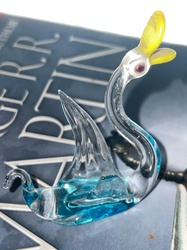
This is a small, handcrafted art glass figurine depicting a penguin. The primary material appears to be clear glass, shaped to form the body and wings of the penguin. The front of the body features an opaque white glass, mimicking the penguin's belly. The top of the head is dark, likely black or a very dark gray glass, and there's a distinct splash of bright yellow glass on the face, representing the beak or possibly a crest feature. The feet are depicted as two small, flattened, dark (black) glass elements attached to the base. The construction appears to be solid glass, possibly lamp-worked or blown, with different colored glass elements fused together. The overall form is simplified and stylized, with smooth, rounded edges typical of art glass figurines. The size is relatively small, suitable for a desk or shelf display. No visible artist's signatures, maker's marks, or stamps can be discerned from the provided image, suggesting it might be a generic art glass piece or part of a larger collection. The condition appears to be good, with no obvious chips, cracks, or repairs, and it retains its original glossy finish. It likely dates to the late 20th century or early 21st century, a common period for decorative art glass. The craftsmanship, while not overly intricate, demonstrates a careful assembly of colored glass elements to create a charming decorative object.
AI Appraisal Report
Based on my visual examination of the provided image, this art glass penguin figurine appears to be in excellent condition. There are no discernible chips, cracks, or repairs, and the glossy finish is well-preserved. The craftsmanship, while not exceptional, is consistent with mass-produced or small studio art glass. The fusion of clear, opaque white, dark (likely black), and yellow glass elements is neatly executed, indicating careful, though perhaps not highly specialized, construction.
Authenticity, in terms of its material and origin as art glass, is readily apparent from the visual characteristics. However, without any visible artist's signatures or maker's marks, it is impossible to attribute this piece to a specific artist or studio. This lack of identification places it in the general decorative art glass market.
Market conditions for generic art glass figurines like this are generally modest. Comparables in the secondary market, such as online marketplaces or antique malls, typically fall within a modest price range for similar-sized, unsigned, decorative glass pieces. Demand for such items is consistent but not high, primarily appealing to collectors of penguin memorabilia or decorative art glass enthusiasts looking for accent pieces. Rarity is low; similar stylized animal figurines are commonly available.
Factors significantly impacting value are the absence of a known maker, which prevents it from entering the collectible market for specific artists, and its relatively simple design. Its small size is also a factor, as larger or more intricate pieces often command higher prices.
It is important to note that my assessment of authenticity is limited to visual inspection. A full authentication would ideally involve in-person examination to verify glass quality, weight, and to search for any faint or hidden marks. Provenance documentation, detailing the item's history, would also be invaluable, but is rarely available for generic items. Scientific testing, such as spectroscopy, is generally reserved for high-value items and would be unnecessary for this piece.