AI estimate as of September 8, 2025 · verify with a professional before acting
AI-Generated · Verify before acting
Everything on this page is generated by AI for informational purposes only. AI can make mistakes — the AI may misidentify items or misattribute them (artist, maker, brand, designer, origin, era). This is not an official valuation and should not be used for insurance, sale, tax, estate, legal, or lending purposes — or any decision requiring a certified appraisal. It is not an authoritative claim about any person, brand, or rights holder — do not share or rely on it as a factual statement about a third party. Always consult qualified professionals before making financial decisions.
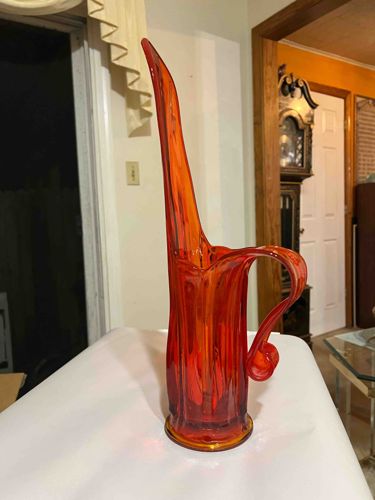
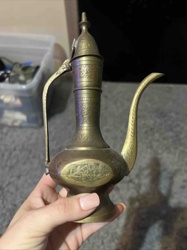
This is a tall, slender vase or ewer crafted from what appears to be hand-blown glass, exhibiting characteristics typical of Murano or Murano-style artistry. The dominant color is a vibrant orange or amber, which transitions to a deeper red in certain areas, likely due to varying thickness of the glass, creating a rich ombre effect. The body of the vase is vertically ribbed, giving it a fluted texture that adds visual interest and depth. From its base, the vase tapers slightly inward before flaring out towards the rim. A prominent feature is the dramatically pulled upper section, extending upward into a long, pointed finial, reminiscent of a flame or a stylized bird's head. On one side, a graceful loop handle extends from near the rim, curving downwards and terminating in a decorative, scrolled detail near the mid-body. The base of the vase is circular and slightly thicker than the body, providing stability. The overall form suggests an absence of significant damage; no obvious chips, cracks, or repairs are visible. The glass exhibits a high degree of transparency and gloss, indicating good preservation of its original finish. The craftsmanship suggests a significant level of skill in glassblowing, with a smooth, continuous form and expertly applied handle. The piece is likely mid-20th century to contemporary, given its stylistic elements.
AI Appraisal Report
Based on my visual examination of the provided image, this Murano-style pulled glass vase/ewer appears to be in very good condition. I observe no obvious chips, cracks, or repairs, and the glass retains a high degree of transparency and gloss, suggesting excellent preservation. The vibrant orange/amber to red ombre effect and vertical ribbing are characteristic of skilled glassblowing. The dramatically pulled finial and graceful loop handle are well-executed.
Authenticity: While exhibiting strong stylistic traits of Murano or Murano-style glass, definitively authenticating it as true Murano from images alone is impossible. Many studios produced similar high-quality 'Murano-style' glass. Without a clear Murano signature, label, or provenance documentation, I cannot confirm its origin from Murano, Italy. An in-person examination would allow me to check for pontil marks, internal inclusions, and subtle glass characteristics. Scientific testing could analyze glass composition, but this is rarely done for decorative arts of this value.
Market Conditions & Comparables: The market for decorative art glass, especially Murano or Murano-style pieces, remains steady. Pieces with unique forms and good condition, like this one, generally perform well. This pulled-glass design is less common than more traditional vases, adding to its appeal. For comparable 'Murano-style' pieces of this size and quality without definitive Murano provenance, typical auction and retail prices range from $200-$500.
Demand & Rarity: There is a consistent demand for colorful, well-made art glass. While Murano glass is widely collected, this particular sculptural form, combined with the ombre coloring and pulled elements, gives it a degree of uniqueness. This design is not exceedingly rare, but it stands out from more generic vases.
Factors Impacting Value: The excellent cosmetic condition, visually appealing color transition, and the dramatic, well-executed pulled form significantly contribute to its value. The primary limiting factor on value is the unknown origin and lack of definitive authentication as true Murano glass, which, if proven, could significantly increase its appraisal range.