AI estimate as of November 6, 2025 · verify with a professional before acting
AI-Generated · Verify before acting
Everything on this page is generated by AI for informational purposes only. AI can make mistakes — the AI may misidentify items or misattribute them (artist, maker, brand, designer, origin, era). This is not an official valuation and should not be used for insurance, sale, tax, estate, legal, or lending purposes — or any decision requiring a certified appraisal. It is not an authoritative claim about any person, brand, or rights holder — do not share or rely on it as a factual statement about a third party. Always consult qualified professionals before making financial decisions.
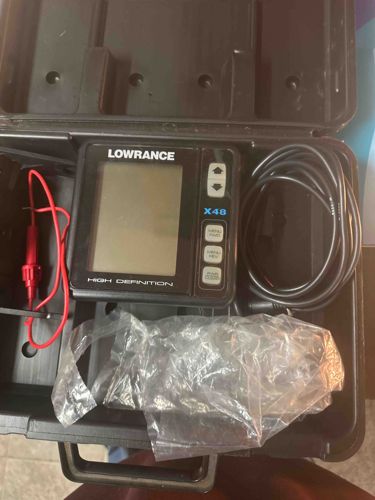
The item is a Lowrance X48 High Definition Fish Finder, presented within what appears to be its original or a compatible hard-shell protective carrying case. The fish finder unit itself is predominantly black, rectangular in shape, and features a monochrome display screen. Above the screen, the brand name 'LOWRANCE' is prominently displayed in white capital letters. Below the screen, the text 'HIGH DEFINITION' is visible. To the right of the screen, there is a vertical column of control buttons. At the top of this column are two arrow buttons (up and down), followed by the model designation 'X48' in blue text. Below the X48 text, there are several square or rectangular buttons with white labels, including 'MENU | PWR', 'LIGHT | Z-IN', and 'FISH ID | Z-OUT'. The physical construction appears to be a durable plastic, typical for marine electronics. The unit is nestled within a custom-fitted cut-out in the hard case, suggesting it's well-protected for transport and storage. Accompanying the fish finder in the case is a tangled black coiled cable, likely the transducer cable or power cable, and a small red and black electrical connector with alligator clips, possibly for connecting to a power source. There's also a clear plastic bag, somewhat crumpled, which may contain additional accessories or documentation. The overall condition, based on the image, appears to be good with no obvious signs of heavy wear, cracks, or significant damage to the unit or the case. The screen looks clean, and the buttons seem intact. This model is likely from the late 1990s or early 2000s, reflecting an older generation of fishing electronics before the widespread adoption of color screens and more advanced imaging technologies. The craftsmanship appears robust, designed for outdoor and marine environments.
AI Appraisal Report
I have examined the provided image of the Lowrance X48 High Definition Fish Finder within its protective case. Based on its appearance, the unit is in surprisingly good cosmetic condition for its age. The screen appears clear, and the buttons are intact, suggesting minimal heavy use or careful storage. The accompanying accessories, including cables and connectors, further indicate a complete, or near-complete, original setup. The hard-shell case adds significant protection and suggests an owner who valued the equipment.
Authenticity is not a major concern here; the branding (LOWRANCE, X48) is consistent with known models from the late 1990s/early 2000s. The critical limitation from images alone is functional verification. I cannot assess if the unit powers on, if the display functions correctly without dead pixels or lines, or if the transducer (presumably attached to the coiled cable) is operational. These are crucial aspects for marine electronics.
Market conditions for an older monochrome fish finder like the X48 are generally low. While Lowrance is a reputable brand, technology in marine electronics has advanced significantly. Modern units offer color screens, GPS, side/down imaging, and greater power. This unit primarily holds value for a collector interested in nostalgic fishing equipment, someone needing a very basic backup unit, or for parts. Demand is extremely limited. The X48 is neither rare nor exceptionally sought after. The excellent cosmetic condition and protective case slightly enhance its appeal but do not overcome the technological obsolescence.
Factors significantly impacting value are the age and limited functionality compared to modern units, balanced by its apparent good cosmetic upkeep. For full authentication and valuation, I would need a physical inspection to power on the unit, test all button functions, and ideally test with a transducer in water to confirm sonar operation. Without this, the value remains firmly in the lower range, primarily as a collectible or for very basic, non-critical use.