These notes were written by the person who submitted this item. Appraiser.AI has not verified them, and the AI's identification and estimate may rely on them.
AI Estimated Value
Not an official valuation
$60 - $120
AI estimate as of October 8, 2025 · verify with a professional before acting
AI-Generated · Verify before acting
Everything on this page is generated by AI for informational purposes only. AI can make mistakes — the AI may misidentify items or misattribute them (artist, maker, brand, designer, origin, era). This is not an official valuation and should not be used for insurance, sale, tax, estate, legal, or lending purposes — or any decision requiring a certified appraisal. It is not an authoritative claim about any person, brand, or rights holder — do not share or rely on it as a factual statement about a third party. Always consult qualified professionals before making financial decisions.
This analysis also relies on unverified notes provided by the user, which may be incomplete or inaccurate and could affect the result.
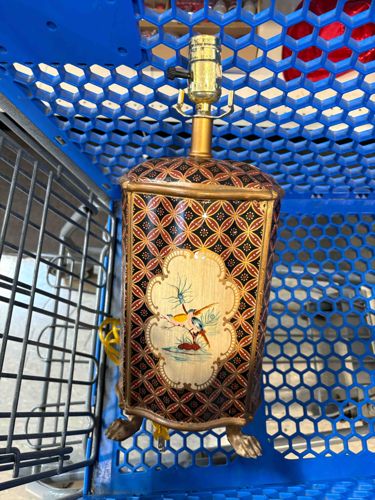
This is a decorative table lamp, characterized by its rectangular, column-like body and an ornate, Asian-inspired aesthetic. The main body of the lamp features a rich, dark brown or black background adorned with a geometric pattern of gold and red floral or medallion-like shapes, creating a tapestry-like effect. Centrally located on at least one face of the lamp is a cartouche-shaped panel with a light, possibly cream or pale yellow, background. Within this panel, a vibrant scene depicts two birds perched amidst sparse foliage, possibly bamboo or reeds, over a body of water. The colors used in the bird motif are bright and contrasting, including blues, yellows, oranges, and greens. The lamp stands on four ornate, possibly cast metal, feet that resemble animal paws or stylized claw feet, finished in a metallic gold or brass tone. The top of the lamp tapers slightly and culminates in a standard brass-toned lamp harps and socket assembly, consistent with a modern electrical fixture. The overall construction appears to be a composite material, possibly wood or resin, covered with decorative paper or a painted finish, though resin is suggested by the molded feet. The 'Made in China' marking indicates its country of origin, suggesting a 20th to 21st-century manufacturing date, likely mass-produced for the decorative home goods market. The lamp exhibits signs of light wear, consistent with age and handling, such as minor scuffs or dust, but no major damage or repairs are immediately evident. The style blends Chinoiserie elements with traditional lamp design. Quality indicators include the detailed application of the decorative patterns and the molded feet.
AI Appraisal Report
I have examined the provided image of the Asian-Inspired Decorative Table Lamp with Bird Motif. My assessment of its condition is good, showing light wear consistent with age and handling, such as minor scuffs or dust. There are no visible major damages or repairs. The 'Made in China' marking indicates its country of origin, supporting a 20th to 21st-century manufacturing date. Authenticity, based solely on the image, suggests it is a decorative, mass-produced item rather than an antique or a unique artisan piece. The composite material (likely resin) and decorative finish are typical for this production style.
Market conditions for decorative table lamps of this type, especially those mass-produced, are generally stable but do not command high prices in the secondary market. Comparables for 'Asian-inspired' or 'Chinoiserie-style' lamps without significant age or provenance typically range from $50-$150, depending on the quality of the decorative application and overall condition. Demand for such items is moderate, driven by buyers seeking decorative accents rather than investment pieces. Rarity is low due to its likely mass-produced nature.
The primary factors impacting its value are its decorative appeal, functional condition, and the overall good state of the applied patterns and molded feet. Its 'Made in China' origin, while not inherently negative, positions it within a category of generally lower-priced decorative home goods.
Limitations in authenticity verification from images alone are significant. While the 'Made in China' stamp is visible, a physical examination would be necessary to confirm the exact material composition (e.g., distinguishing between resin, wood, or other composites) and the quality of the decorative application. Provenance documentation could potentially elevate its value if it were part of a notable collection, but this is unlikely for such an item. Scientific testing is not typically applied to items of this nature as it wouldn't significantly alter its market value given its likely mass-produced status.