AI estimate as of September 6, 2025 · verify with a professional before acting
AI-Generated · Verify before acting
Everything on this page is generated by AI for informational purposes only. AI can make mistakes — the AI may misidentify items or misattribute them (artist, maker, brand, designer, origin, era). This is not an official valuation and should not be used for insurance, sale, tax, estate, legal, or lending purposes — or any decision requiring a certified appraisal. It is not an authoritative claim about any person, brand, or rights holder — do not share or rely on it as a factual statement about a third party. Always consult qualified professionals before making financial decisions.
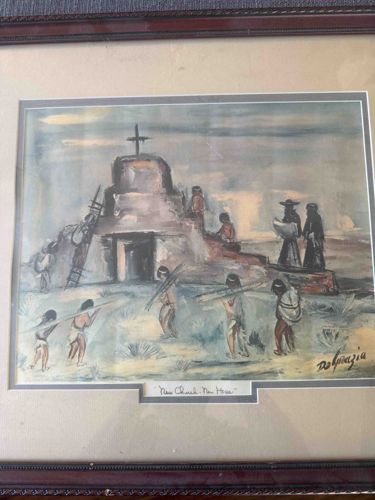
This item is a framed watercolor painting titled "New Church, New Hope," as indicated by the inscription on the bottom center of the mat. The artwork depicts a scene of people, likely Native American, engaged in activities around a mission-style church building, which appears to be under construction or undergoing renovation, evidenced by ladders leaning against it and a cross prominently displayed on its roof. The figures are rendered in a slightly abstract or simplified style, with some carrying bundles of sticks or wood, suggesting they are contributing to the building effort. Two figures on the right appear to be observing or discussing, one holding what resembles a scroll or map. The color palette is muted, consisting primarily of grays, blues, Browns, and earthy tones, with hints of red and orange in the figures' attire, characteristic of a watercolor medium. The painting is housed within a brown, possibly wooden, frame with a decorative carved or molded edge, and a light earth-toned mat, which shows some signs of age or discoloration, particularly around the edges of the mat opening and some possible minor staining. The condition of the painting itself appears good, although it is difficult to assess through the glass. The artist's signature, "R.C. Gorazia" or "R.O. Gorazia" (first initial is somewhat unclear), is visible in the lower right corner of the painting. The artistic style suggests a mid-20th century Southwestern or Western American influence, capturing a sense of community and endeavor. The craftsmanship of the painting appears competent, showcasing an understanding of watercolor techniques.
AI Appraisal Report
I have examined the provided image of the framed watercolor painting titled "New Church, New Hope." The artwork depicts a mission-style church under construction, with figures, likely Native American, contributing to the effort. The muted color palette and simplified figures are characteristic of watercolor. The artist's signature, “R.C. Gorazia” or “R.O. Gorazia,” is visible in the lower right. The painting itself appears to be in good condition, though assessing this fully through glass and an image is difficult. The mat shows signs of age, including discoloration and possible minor staining, which detracts slightly from the overall presentation.
Authenticity, based solely on imagery, is hard to confirm definitively; without a physical examination of the signature and the work itself, as well as an understanding of the artist's oeuvre, I cannot fully verify its originality. I would need to research the artist "R.C. Gorazia" or "R.O. Gorazia" to establish their market presence and typical pricing structure. This style, suggestive of mid-20th century Southwestern or Western American art, has a consistent but not exceptionally high demand unless by a well-established artist. The absence of a prominent artist name and detailed provenance documentation limits its market appeal.
Comparable sales for similar framed watercolors by lesser-known artists, particularly those without strong exhibition histories, typically range in the lower hundreds. Factors impacting value include the condition of the mat and frame, which would benefit from professional conservation or replacement. For full authentication and to ascertain provenance, I would require an in-person examination, any available documentation (e.g., bills of sale, exhibition catalogs), and possibly consultation with experts familiar with this specific artistic region and period. Without such, the value remains conservative.