AI estimate as of August 8, 2025 · verify with a professional before acting
AI-Generated · Verify before acting
Everything on this page is generated by AI for informational purposes only. AI can make mistakes — the AI may misidentify items or misattribute them (artist, maker, brand, designer, origin, era). This is not an official valuation and should not be used for insurance, sale, tax, estate, legal, or lending purposes — or any decision requiring a certified appraisal. It is not an authoritative claim about any person, brand, or rights holder — do not share or rely on it as a factual statement about a third party. Always consult qualified professionals before making financial decisions.
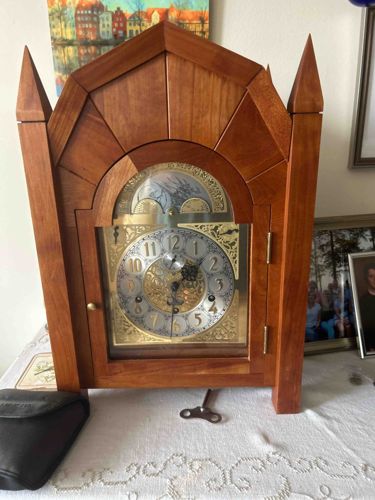
This is a wooden mantle clock, distinguished by its unique architectural form resembling a Gothic or cathedral style. The wood appears to be a medium-toned hardwood, possibly cherry or a similar species, with a smooth, polished finish that highlights a subtle grain. The case is constructed with mitered joints and routed edges, particularly evident in the arched section above the dial and the pointed finials on either side of the top. The overall dimensions suggest it is of a substantial size, suitable for a mantle or large shelf.
The clock face features a brass or gold-toned surround with intricate embossed or engraved patterns, possibly depicting floral or scroll motifs. The main dial has a silver-toned background with clear Roman numerals for hours and minutes marked by thinner lines. A smaller sub-dial is visible within the main dial, likely for seconds or a moon phase indicator, and a day/night indicator disk is visible in the upper arc of the clock face. The hands are dark-toned and ornate. The glass covering the dial is clean and clear.
The clock appears to be in very good condition with no apparent significant damage such as cracks, chips, or deep scratches on the wood. The metal components of the dial and hinges show a light patina consistent with age but no heavy tarnishing or corrosion. No obvious maker's marks are discernible from the provided images, but the craftsmanship suggests a piece of reasonable quality. The presence of a winding key indicates it is a mechanical clock, adding to its traditional appeal. This piece likely dates from the mid-to-late 20th century, given its relatively clean lines and the style of the dial.
AI Appraisal Report
Upon examining this Gothic Style Wooden Mantle Clock, I assess its condition as very good. The wooden case exhibits no visible cracks, chips, or deep scratches; its polished finish and subtle grain are well-preserved. The mitered joints and routed edges, particularly in the arched section and finials, demonstrate quality craftsmanship. The brass/gold-toned dial surround shows a light, age-consistent patina, free from heavy tarnishing. The clear Roman numerals and ornate hands are intact, and the glass covering is clean. Authenticity, based solely on visual inspection, appears consistent with a mid-to-late 20th-century mechanical mantle clock of reasonable quality. Market conditions for decorative mantle clocks remain stable, with a steady demand, especially for well-maintained pieces with distinctive architectural styles. Comparable pieces with similar Gothic or cathedral styling, particularly those with intricate dials (like the sub-dial and day/night indicator seen here), typically fetch higher prices. While not exceptionally rare, its unique aesthetic contributes to its appeal. Factors significantly impacting value include its very good condition, intricate dial details, and the apparent mechanical winding mechanism. The absence of discernible maker's marks is a minor limiting factor, as it prevents attributing the piece to a known manufacturer, which could elevate its value. Limitations in authenticity verification from images alone include the inability to inspect the internal movement for maker's marks or assess its functional condition (timekeeping accuracy, chime, etc.). An in-person examination would involve opening the case to inspect the movement, verify materials (e.g., wood species), and a physical assessment of the clock's operational status. Provenance documentation (receipts, ownership history) would further solidify its history and potential value. Without these, the appraisal remains largely based on external visual characteristics and general market trends for comparable items.