AI estimate as of October 5, 2025 · verify with a professional before acting
AI-Generated · Verify before acting
Everything on this page is generated by AI for informational purposes only. AI can make mistakes — the AI may misidentify items or misattribute them (artist, maker, brand, designer, origin, era). This is not an official valuation and should not be used for insurance, sale, tax, estate, legal, or lending purposes — or any decision requiring a certified appraisal. It is not an authoritative claim about any person, brand, or rights holder — do not share or rely on it as a factual statement about a third party. Always consult qualified professionals before making financial decisions.
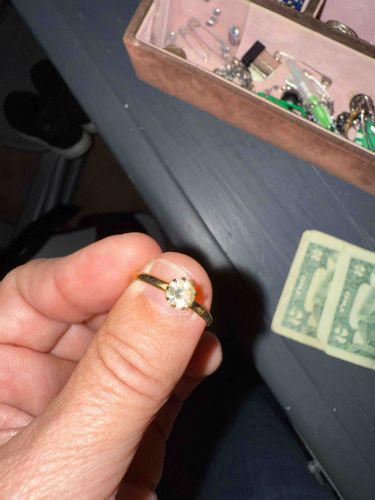
The item is a solitaire-style ring, held between the thumb and forefinger of a person. The ring features a single, round, faceted clear stone, likely a diamond simulant or a genuine diamond, set prominently in a six-prong setting. The stone appears to be approximately 5-6mm in diameter, exhibiting a bright sparkle that suggests good cut quality, though clarity and color cannot be definitively assessed from the image. The band of the ring is a slender, polished, plain gold-tone metal, which could be yellow gold or a gold-plated base metal. The setting appears to be a classic Tiffany-style or similar raised design, allowing light to enter the stone from multiple angles. There are no visible manufacturer's marks or engravings discernible in the image. The condition of the ring appears to be good with a visible shine, though minor surface wear or scratches on the band are possible but not clearly depicted. There are no obvious signs of damage, repairs, or heavy patina. The overall aesthetic suggests a timeless and popular engagement ring or promise ring style, potentially dating anytime from the mid-20th century to the present, depending on the materials. The craftsmanship appears standard for mass-produced or fine jewelry, with a focus on showcasing the central stone.
AI Appraisal Report
Based on my visual examination of the provided image, this is a solitaire-style ring featuring a round, faceted clear stone, approximately 5-6mm in diameter, set in a six-prong setting on a slender, polished, gold-tone band. The ring appears to be in good condition, showing a bright shine and no obvious damage or heavy wear. The setting is a classic raised design, allowing light to beautifully interact with the stone, suggesting good cut quality.
However, limitations in authenticity verification from an image are significant. The most crucial factor impacting value is the identity of the clear stone and the metal of the band. If the stone is a diamond simulant (e.g., cubic zirconia, moissanite) and the band is gold-plated base metal, the retail value would likely be in the $100-$300 range. If the stone is a genuine diamond of decent quality (I-J color, SI clarity or better, assuming good cut based on sparkle) and the band is 10k or 14k gold, the value could range from $800 to $3,000 or more, depending heavily on the diamond's exact 4 C's. There are no visible hallmarks or engravings in the image to help identify the metal purity or stone.
Market demand for classic solitaire rings remains consistently strong. Their timeless appeal ensures steady desirability. Without an in-person examination, the authenticity of the stone (natural diamond vs. simulant) and the metal composition cannot be definitively determined. Full authentication would require a physical inspection to test for diamond authenticity (e.g., thermal conductivity, reflectivity), assess clarity and color under magnification, weigh the stone, perform metal testing (e.g., XRF analysis, acid test for karatage), and check for hallmarks. Provenance documentation, such as a jeweler's certificate or original sales receipt, would also be invaluable in confirming the material content and origin, significantly impacting the final appraised value.