AI estimate as of July 24, 2025 · verify with a professional before acting
AI-Generated · Verify before acting
Everything on this page is generated by AI for informational purposes only. AI can make mistakes — the AI may misidentify items or misattribute them (artist, maker, brand, designer, origin, era). This is not an official valuation and should not be used for insurance, sale, tax, estate, legal, or lending purposes — or any decision requiring a certified appraisal. It is not an authoritative claim about any person, brand, or rights holder — do not share or rely on it as a factual statement about a third party. Always consult qualified professionals before making financial decisions.
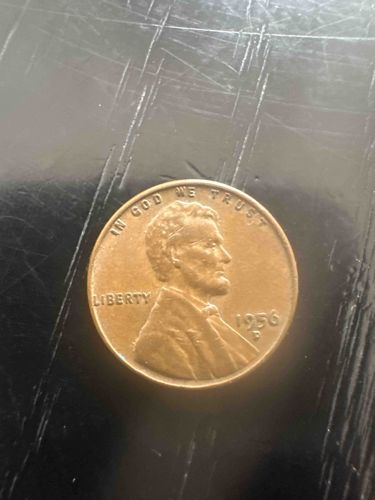
The item is a United States one-cent coin, commonly known as a Lincoln Wheat Cent. It is circular in shape and appears to be made of a bronze or copper alloy, exhibiting the typical reddish-brown coloration associated with this material, though some areas show a darker patina. The obverse prominently features a right-facing bust of Abraham Lincoln, designed by Victor David Brenner. Above Lincoln's head, the national motto "IN GOD WE TRUST" is clearly visible in an arc. To the left of Lincoln, the word "LIBERTY" is inscribed along the rim, and to his right, the minting year, "1956," is legible. Below the '1956', a faint 'P' can be seen, indicating it was minted at the Philadelphia Mint. While the overall details of Lincoln's portrait are discernible, there is evidence of moderate wear across the coin's surface, particularly on the higher points of the relief such as Lincoln's cheekbone and hair, suggesting it has been in active circulation. There are no immediate signs of significant damage like deep scratches or gouges, but minor surface abrasions and handling marks are present, consistent with a circulated coin. The rim appears mostly intact, but may show slight flattening in some areas due to wear. The craftsmanship is typical of U.S. coinage from this period, characterized by industrial minting processes. This specific coin, dated 1956, falls within the later years of the Lincoln Wheat Cent series (1909-1958) before the reverse design changed to the Lincoln Memorial.
AI Appraisal Report
I have examined the provided image of your 1956 Lincoln Wheat Cent from the Philadelphia Mint. Based on the visual evidence, I can confirm its authenticity as a genuine U.S. one-cent coin from that period. The inscription, Lincoln's bust, and the mint date are consistent with known specimens. The `P` mint mark, though faint, is discernible, aligning with the Philadelphia origin.
The coin exhibits moderate circulation wear, particularly on high points like Lincoln's cheekbone and hair, leading me to grade it in the Fine (F) to Very Fine (VF) range. While the details are still visible, the original luster is absent, and there are minor surface abrasions consistent with a coin that has been in active circulation. There are no obvious signs of significant damage such as deep scratches, bends, or environmental corrosion, which would drastically reduce its value.
From a market perspective, 1956 Lincoln cents, especially from Philadelphia, are common. Millions were minted, making them readily available to collectors. Their rarity is low, and thus the demand for circulated examples is not exceptionally high. The value is primarily driven by their historical appeal and the general collectibility of the Wheat Cent series. Uncirculated examples, particularly those with Full Red (FR) designations, command significantly higher prices, but this coin does not fall into that category.
The primary limiting factor in providing a definitive appraisal is the reliance on imagery alone. While I can assess the general condition and authenticity, an in-person examination would allow for a more precise grading, including assessments of subtle planchet errors, re-punched mint marks, or die varieties that are not discernible from photos. Furthermore, physical inspection allows for detailed surface analysis under magnification to detect hairline scratches, cleaning, or environmental damage more acutely. Scientific testing, such as spectrometric analysis, would confirm the metallic composition but is not typically necessary for standard Lincoln cents. Provenance documentation, while not usually available or necessary for common circulated coins, could add value to rarer or higher-grade examples. Given the coin's commonality and circulated condition, its value is modest.