AI estimate as of July 5, 2025 · verify with a professional before acting
AI-Generated · Verify before acting
Everything on this page is generated by AI for informational purposes only. AI can make mistakes — the AI may misidentify items or misattribute them (artist, maker, brand, designer, origin, era). This is not an official valuation and should not be used for insurance, sale, tax, estate, legal, or lending purposes — or any decision requiring a certified appraisal. It is not an authoritative claim about any person, brand, or rights holder — do not share or rely on it as a factual statement about a third party. Always consult qualified professionals before making financial decisions.
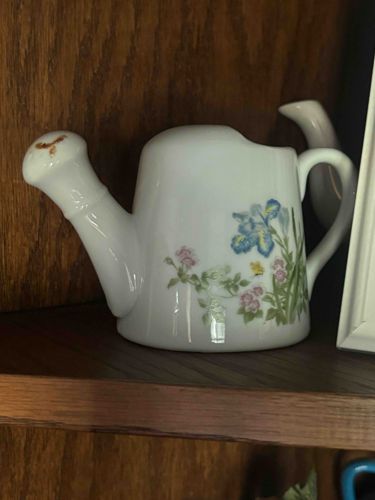
This item is a decorative miniature watering can, likely made of ceramic or porcelain, based on its smooth, white, glossy finish. Its overall form mimics a traditional watering can, featuring a gracefully curved spout on the left and a C-shaped handle on the right. A prominent opening at the top serves as the fill point. The primary decorative element is a floral motif, hand-painted or decaled, adorning the front and right side of the body. This vibrant design includes blue iris flowers, pink roses, green foliage, and what appears to be a small yellow bee, suggesting a spring or garden theme. The colors are soft yet distinct, indicative of a classic cottage or shabby chic aesthetic. The surface shows some signs of wear, particularly on the tip of the spout, where there's a visible brown discoloration or scuff mark, hinting at possible interaction with other surfaces or past handling. The craftsmanship appears to be commercially produced, possibly from the late 20th century or early 21st century, designed as an accent piece rather than a functional tool. There are no immediate visible maker's marks or signatures, though they might be present on the base, which is not visible in the image. The item's condition otherwise seems good, with no obvious cracks or chips beyond the noted discoloration on the spout. Its petite size, typical for decorative miniatures, suggests it was intended for display on a shelf, as observed in the provided image.
AI Appraisal Report
I have examined the provided image of the Miniature Floral Ceramic Watering Can. Based on visual assessment, the item appears to be a decorative ceramic or porcelain piece, likely mass-produced in the late 20th or early 21st century. The floral motifs, including blue irises, pink roses, and a bee, suggest a cottage or garden aesthetic. The condition is generally good, with no obvious cracks or chips seen, though there is a scuff or discoloration on the spout's tip, indicating minor wear from handling or contact. Authenticity cannot be fully verified from images alone; without a physical inspection, I cannot confirm materials definitively, nor can I locate any maker's marks or signatures, which would typically be on the base. Market conditions for decorative miniatures of this type are modest, driven by personal taste rather than collector demand for rare or historically significant pieces. Comparables typically sell in gift shops or online marketplaces for similar mass-produced decor. Demand is low to moderate, and the item holds no inherent rarity. Factors impacting value negatively include its likely mass-produced nature, lack of identifiable provenance or artist signature, and minor wear. Its primary value is decorative. For full authentication and a more precise appraisal, an in-person examination would be critical to assess material composition, identify any hidden marks, and determine manufacturing techniques more accurately. Provenance documentation would also add significant value if available. Without these, the appraisal remains limited.