AI estimate as of July 26, 2025 · verify with a professional before acting
AI-Generated · Verify before acting
Everything on this page is generated by AI for informational purposes only. AI can make mistakes — the AI may misidentify items or misattribute them (artist, maker, brand, designer, origin, era). This is not an official valuation and should not be used for insurance, sale, tax, estate, legal, or lending purposes — or any decision requiring a certified appraisal. It is not an authoritative claim about any person, brand, or rights holder — do not share or rely on it as a factual statement about a third party. Always consult qualified professionals before making financial decisions.
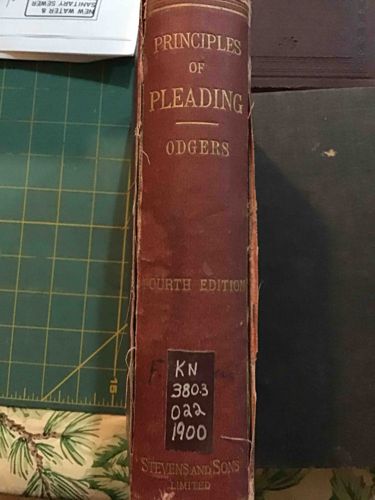
The item is an antique legal textbook titled "Principles of Pleading" by Odgers, specifically identified as the Fourth Edition. The book's spine is crafted from a deep reddish-brown material, likely leather or a similar durable binding cloth, which has developed a rich patina over time. The title, author, and edition are embossed or printed in a gold or light-colored font, which appears to be somewhat faded or worn in areas, particularly around the edges of the letters. Below the main title information, there's a white label, possibly a library or archival sticker, bearing the classification numbers "KN 3803," "O22," and the year "1900." This year likely indicates the publication date or the date of acquisition/cataloging. At the very bottom of the spine, the publisher's name, "STEVENS AND SONS LIMITED," is visible, also in a similar light-colored or gold lettering, though it is quite faded and difficult to read clearly.
The physical condition indicates significant wear consistent with its age and likely frequent handling. The edges of the spine are severely frayed and detached from the book block in several places, particularly along the front hinge, exposing the underlying binding structure. There are visible scuffs, scratches, and discoloration across the spine surface. The top and bottom edges of the spine are also worn, with material loss. Despite the visible damage, the overall structure of the book, while compromised, appears to remain somewhat intact, suggesting the quality of its original construction. The craftsmanship, evident in the detailed lettering and the choice of durable materials, points to a period when books were built to last, often for professional reference. The condition issues, while extensive, contribute to its antique character and provide a clear history of its use.
AI Appraisal Report
I have examined the provided image of "Principles of Pleading" by Odgers, Fourth Edition (1900). My assessment is based solely on this visual information; a definitive appraisal would require a physical inspection. This legal textbook, published by Stevens and Sons Limited, displays considerable wear consistent with its age and intended use as a professional reference. The reddish-brown spine, likely leather or similar material, shows significant fraying, scuffs, and material loss, particularly along the hinges. The gold lettering for title, author, and publisher is faded. A white label with classification numbers "KN 3803," "O22," and "1900" is present.
Regarding authenticity, visually, the details align with a genuine 1900 publication from Stevens and Sons. However, without physical examination, I cannot attest to the book's completeness (e.g., presence of all pages, plates), any internal damage (e.g., foxing, mold), or repairs. Verifying the paper quality, binding integrity beyond the spine, and printing methods would also require in-person inspection. Provenance documentation (e.g., prior ownership records, library stamps) would further strengthen authenticity and historical context.
From a market perspective, antique legal textbooks are generally a niche market. While the subject matter is foundational, this specific edition's value is more tied to its age and historical curiosity than high demand, especially given its condition. Comparable sales for similar legal texts from this period, particularly those in rougher condition, tend to be low. Collectors often prioritize books in better states of preservation. Rarity is not a significant factor here; while a specific edition, these types of texts were produced in relatively large quantities for professional use. The extensive damage to the spine significantly detracts from its aesthetic appeal and structural integrity, which are key value drivers for antique books. This condition pushes its value towards the lower end of the spectrum for historical texts.
Key factors impacting value negatively are the severe deterioration of the spine and overall heavy wear. Positive factors include its age (over 120 years old) and its historical significance within the field of legal studies as a representative text from the turn of the 20th century. However, due to its condition, its primary value is as a historical artifact rather than a prime collectible example.