AI estimate as of November 28, 2025 · verify with a professional before acting
AI-Generated · Verify before acting
Everything on this page is generated by AI for informational purposes only. AI can make mistakes — the AI may misidentify items or misattribute them (artist, maker, brand, designer, origin, era). This is not an official valuation and should not be used for insurance, sale, tax, estate, legal, or lending purposes — or any decision requiring a certified appraisal. It is not an authoritative claim about any person, brand, or rights holder — do not share or rely on it as a factual statement about a third party. Always consult qualified professionals before making financial decisions.
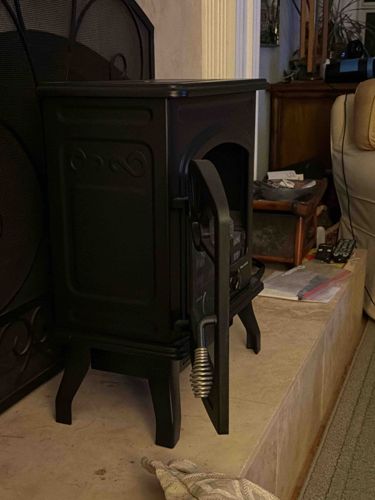
This appears to be a compact, black cast iron wood-burning stove, likely designed for supplemental heating in a smaller space or as a decorative and functional piece. The stove features a predominantly dark, possibly matte black finish, typical of high-temperature stove paint. Its construction is primarily cast iron, evident from the robust appearance and the decorative flourishes on the side panel, which include an embossed scroll or foliate motif. The stove stands on four short, splayed legs, providing a stable base and elevating the main body off the floor, presumably for heat dispersion and stability. The front of the stove has a hinged door, currently ajar, revealing the interior firebox. The door itself is thick and solid, suggesting good insulation and heat retention. Attached to the door is a coiled metal spring handle, which is a common feature on wood stoves as it stays cooler to the touch during operation. The overall form is box-like with a slightly curved top edge, adding a touch of classic stove design. The absence of visible glass in the door might suggest an older model or a specific design choice focused on efficiency over viewing the fire. The condition appears well-maintained with no obvious signs of significant rust, dents, or damage. There might be some minor dust build-up or superficial marks consistent with use, but without closer inspection, these are not clearly discernible as major condition issues. The style suggests it could be a contemporary reproduction with a vintage aesthetic or perhaps an older stove from the mid-20th century. The craftsmanship appears solid and functional, typical for a heating appliance of this type. It is placed on what looks like a tiled hearth or raised platform, indicating its intended use as a heat source.
AI Appraisal Report
Upon visual examination of the provided image, this black cast iron wood-burning stove appears to be in good, well-maintained condition. The matte black finish is largely intact, with no discernible significant rust, dents, or structural damage. The embossed scrollwork on the side adds a decorative touch, suggesting either a vintage piece or a modern reproduction with a classic aesthetic. The coiled spring handle is a functional feature typically found on such stoves to manage heat. The absence of a glass door might indicate an older model focused purely on heating efficiency, though some contemporary compact stoves also omit this feature. While it presents as a functional heating appliance, its compact size suggests it's best suited for supplemental heating in smaller spaces or as a rustic/decorative element.
Market conditions for compact cast iron wood-burning stoves vary. New, similar-sized models from reputable brands can range from $500 to over $1,000, while used contemporary or vintage stoves in good condition often sell for $200-$600, depending on brand, condition, and actual heat output capacity. The demand for such stoves is consistent, particularly in rural areas or for those seeking off-grid heating solutions or a cozy ambiance. This particular stove does not appear to be of a rare or highly collectible brand, which limits its upper value. Factors impacting value include its functional integrity, aesthetic condition, and BTU output (which cannot be determined from the image).
Limitations in authenticity verification are significant based solely on images. Without in-person examination, I cannot definitively ascertain the manufacturer, material composition beyond surface observation, internal firebox condition, or the efficiency rating. An in-person inspection would allow me to check for cracks in the cast iron, verify the integrity of seals, assess the flue collar connection, and identify any manufacturer's marks or model numbers, which would greatly assist in determining its age, brand, and precise value. Provenance documentation, such as original sales receipts or manuals, would be invaluable for full authentication and establishing its history. Without this, my valuation relies on general market comparisons for similar-looking functional used stoves.