AI estimate as of August 31, 2025 · verify with a professional before acting
AI-Generated · Verify before acting
Everything on this page is generated by AI for informational purposes only. AI can make mistakes — the AI may misidentify items or misattribute them (artist, maker, brand, designer, origin, era). This is not an official valuation and should not be used for insurance, sale, tax, estate, legal, or lending purposes — or any decision requiring a certified appraisal. It is not an authoritative claim about any person, brand, or rights holder — do not share or rely on it as a factual statement about a third party. Always consult qualified professionals before making financial decisions.
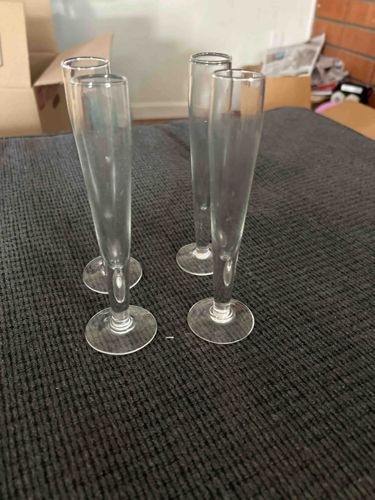
This set consists of four unadorned, clear glass champagne flutes. Each flute features a classic trumpet or elongated bowl shape, narrowing significantly towards the stem, which then connects to a circular footed base. The glass appears to be thin to medium-thickness, suggesting functionality rather than heavy duty decorative use. Given the simple, clean lines and lack of ornamentation, they likely date from the mid-20th century onwards, probably Post-War to Contemporary (1945-present). There are no visible maker's marks, etched designs, or signatures on any of the glasses. The overall transparency indicates standard clear soda-lime glass. In terms of condition, surface scuffs, fingerprints, and some dust are visible, particularly around the rims and on the bowls, but no obvious chips, cracks, or significant damage are discernible from the image. The rims appear to be fire-polished. The craftsmanship seems standard for mass-produced glassware, with uniform shapes across the set. The height of the flutes appears to be approximately 8-10 inches based on their proportion to the surrounding environment and the carpet texture, while the bases are relatively small, contributing to the elegant, slender silhouette. These pieces are simple and functional, suitable for serving sparkling wines or champagne.
AI Appraisal Report
Based on my visual examination of the provided image, this set of four clear glass champagne flutes appears to be in very good, used condition. I note very minor surface scuffs, fingerprints, and dust, but no obvious chips, cracks, or significant damage. The fire-polished rims indicate standard, good quality mass production. Authenticity-wise, these are unadorned, clear glass flutes consistent with post-WWII to contemporary mass-produced glassware. Given the lack of maker’s marks, etching, or unique design, confirming a specific manufacturer or dating without physical examination is impossible.
Market conditions for generic, unbranded clear glass champagne flutes are modest. Comparable new sets of four range from $15-$40, while secondary market (used) prices are typically lower, often $5-$15 per set at thrift stores or online marketplaces for similar items. There is no significant rarity associated with these pieces; they are widely available due to mass production. The primary factors impacting value are their functional condition and their aesthetic simplicity, which appeals to a broad market seeking basic drinkware. However, without any distinguishing features, a premium cannot be justified. Demand is consistent but not high for used, unbranded glassware.
Limitations in authenticity verification are significant; I cannot definitively confirm the precise age, origin, glass composition (beyond being clear soda-lime type), or the exact manufacturer from images alone. An in-person examination would allow for closer inspection of glass clarity, thickness, seam lines, base wear, and potential microscopic maker's marks. Provenance documentation would be crucial to verify any specific historical context or prior ownership that could affect value. Scientific testing (e.g., spectroscopy) would be needed to confirm exact glass composition and aid in more precise dating if such detail were warranted, though it's typically unnecessary for items of this nature.