AI Appraisal Estimate

AI-generated estimates · not official valuations

From the user

What was submitted

Photo and notes provided by the user — not generated by AI

Submitted item photo
Submitted photo · May 16, 2026

User's notes

No additional notes provided.

AI analysis below

AI appraisal

AI analysis & estimate

AI-Generated · Verify before acting

Everything below is generated by AI for informational purposes only. AI can make mistakes — the AI may misidentify items or misattribute them (artist, maker, brand, designer, origin, era). This is not an official valuation and should not be used for insurance, sale, tax, estate, legal, or lending purposes — or any decision requiring a certified appraisal. It is not an authoritative claim about any person, brand, or rights holder — do not share or rely on it as a factual statement about a third party. Always consult qualified professionals before making financial decisions.

Read the full disclaimer

AI Identification

·Not independently authenticated·Verify before acting

Mid-Century Impressionist Street Scene Oil Painting

Fine Art - Painting

AI Estimated Value

·Not an official valuation·Verify before acting

$150 - $300

As of May 16, 2026

AI Item Analysis

·AI can make mistakes·Verify before acting
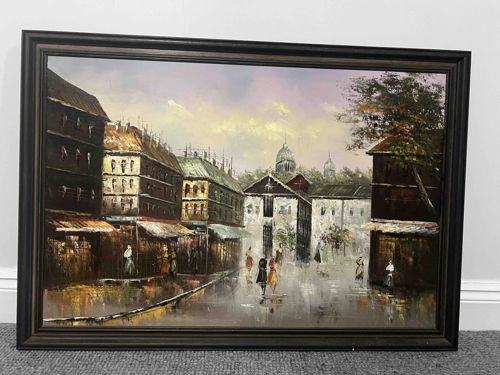
This is a large-scale horizontal oil painting on canvas depicting a bustling European-style city street, likely inspired by mid-20th-century Parisian cafe culture. The composition features multi-story stone buildings lining a wet, reflective cobblestone street, with several stylized human figures appearing in the foreground and mid-ground. The color palette is dominated by earthen tones of burnt umber, sienna, and charcoal, contrasted against a muted lavender and pale yellow sky that suggests dusk or early morning light. In the background, two prominent domed structures emerge, reminiscent of the Sacré-Cœur or similar neoclassical architecture. The artist has utilized a heavy impasto technique, particularly visible in the textured applications of white and cream paint on the building facades and the reflective puddles on the ground. The work is housed in a dark, multi-tiered wooden frame with a gold-tone inner fillet. The style and execution are characteristic of commercial 'vanity' or decor art popularized between the 1960s and 1980s, often produced in studios for the international market. The condition appears stable with no visible punctures or significant paint loss, though the dark frame shows minor scuffing and dust accumulation, and a slight aged patina is present on the canvas surface.


AI Appraisal Report

·AI can make mistakes·Verify before acting
I have conducted a visual examination of the Mid-Century Impressionist Street Scene oil painting. The work is a classic example of mid-to-late 20th-century decorative art, often referred to as 'furniture store art' or 'vanity' pieces. These were produced in high volumes by studios, frequently in Europe or Hong Kong, for the North American interior design market. The use of heavy impasto and a palette-knife technique on a large-scale canvas is characteristic of this genre, designed for immediate visual impact rather than individual artistic expression. The condition appears stable with minor frame abrasions and expected surface dust. The value is driven primarily by its decorative utility and size rather than artist provenance or historical rarity. Market demand for this specific style has softened from its peak in the 1980s, but it remains a staple in secondary markets like estate sales and consignment shops where it serves as an accessible focal point for traditional interiors. Critically, as this appraisal is based on digital images, I cannot verify the age of the canvas, the chemistry of the pigments, or the specific origin of the stretcher bars. A physical inspection is required to check for 'Made in...' stamps on the reverse or artist signatures that may link to known commercial studios. Proving this is a 1960s European-produced piece versus a modern 1990s reproduction would require examining the oxidation of the wood and the weave of the canvas. Because these were mass-produced, provenance documentation is rarely available; however, any original gallery stickers on the dust cover could add modest historical context.

Get your items appraised

Instant estimates of your treasures with AI-powered appraisals

Browse More Appraisals