AI estimate as of August 9, 2025 · verify with a professional before acting
AI-Generated · Verify before acting
Everything on this page is generated by AI for informational purposes only. AI can make mistakes — the AI may misidentify items or misattribute them (artist, maker, brand, designer, origin, era). This is not an official valuation and should not be used for insurance, sale, tax, estate, legal, or lending purposes — or any decision requiring a certified appraisal. It is not an authoritative claim about any person, brand, or rights holder — do not share or rely on it as a factual statement about a third party. Always consult qualified professionals before making financial decisions.
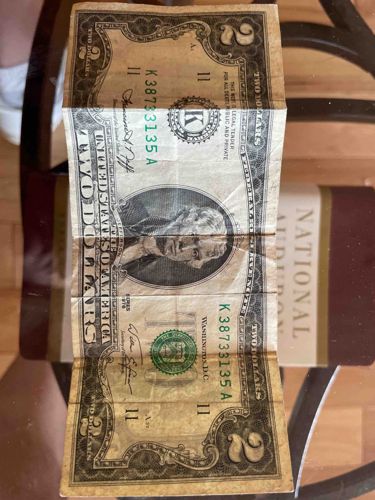
The item is a United States Two Dollar Bill, specifically a Federal Reserve Note. The bill features a portrait of Thomas Jefferson on the obverse. The primary colors are green on a beige-white paper, typical of US currency. Key features visible include the prominent 'TWO DOLLARS' text at the top and bottom, the series number 'K 38733135 A' printed in dark green in two locations on the obverse, and what appears to be a Federal Reserve Bank indicator 'K' within a circular seal, likely for the Dallas Federal Reserve Bank (District 11, 'K'). The signatures of the Treasurer of the United States and the Secretary of the Treasury are also visible below the portrait, though specific names are not clearly legible. The bill shows significant signs of use and wear, including prominent vertical and horizontal folds, especially a strong central vertical crease and several horizontal creases. The paper exhibits a soft, somewhat rumpled texture consistent with circulation. There are no obvious tears or major repairs, but the overall condition suggests heavy handling, indicating a circulated grade rather than uncirculated. The edges appear worn but intact. The vintage of the bill can be inferred from the design and visible markings, placing it likely from the mid to late 20th century. The craftsmanship is standard for U.S. government-issued currency, incorporating security features and detailed engraving.
AI Appraisal Report
Upon examining the provided image of this United States Two Dollar Bill, I can confirm its authenticity as a genuine Federal Reserve Note, consistent with typical U.S. currency design and security features. The portrait of Thomas Jefferson, 'TWO DOLLARS' text, and visible plate numbers/serial numbers (K 38733135 A) align with standard issues. The 'K' Federal Reserve Bank indicator suggests the Dallas district, which is a common issue.
Regarding condition, this bill is clearly circulated. It exhibits significant wear, most notably pronounced vertical and horizontal folds, a soft texture, and general signs of handling. While no major tears or repairs are visible, its condition places it at a grade consistent with 'Good' (G) or possibly 'Very Good' (VG) on the Sheldon scale, far from uncirculated. This heavy circulation severely limits its collectibility premium.
From a market perspective, common issue two-dollar bills, even vintage ones, do not typically command significant premiums in circulated condition. Comparables in similar states of wear generally trade for slightly above face value, if at all, unless they possess specific rarities like star notes, fancy serial numbers, or rare districts/series combinations, none of which are evident here. Demand for common circulated currency is low among serious collectors. Its value is primarily its face value.
Factors impacting value dramatically are condition (negatively impacted by wear), rarity (not present here), and specific identifying marks like a rare series or low serial number (not indicated).
Limitations: While authenticity is highly probable based on visual cues, definitive verification would require in-person examination to assess paper quality, watermarks, microprinting, and color shifts under various light conditions. Provenance documentation could affirm its history, and scientific testing (e.g., UV light, magnification) would confirm ink and paper composition, excluding counterfeits that might mimic visible features but fail on advanced security measures.