AI estimate as of September 24, 2025 · verify with a professional before acting
AI-Generated · Verify before acting
Everything on this page is generated by AI for informational purposes only. AI can make mistakes — the AI may misidentify items or misattribute them (artist, maker, brand, designer, origin, era). This is not an official valuation and should not be used for insurance, sale, tax, estate, legal, or lending purposes — or any decision requiring a certified appraisal. It is not an authoritative claim about any person, brand, or rights holder — do not share or rely on it as a factual statement about a third party. Always consult qualified professionals before making financial decisions.
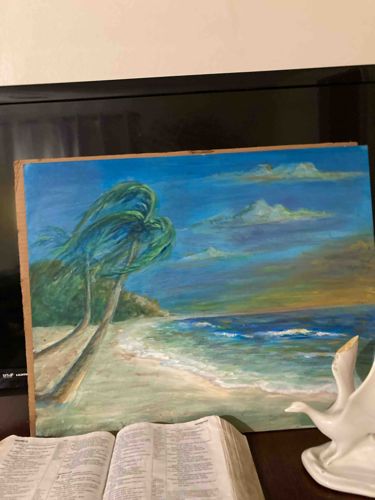
This item is an unframed painting depicting a vibrant tropical beach scene, likely executed in acrylics or oils on a rigid board substrate, possibly wood or hardboard, given the visible raw edges. The painting features two prominent palm trees dominating the left foreground, their fronds rendered in various shades of green and teal, appearing windswept or dynamically styled. The beach itself is a sandy expanse in hues of light yellow and beige, leading into a turquoise ocean with white-capped waves breaking near the shore. The sky is a dramatic composition, transitioning from a bright blue at the top to a more muted, possibly sunset or stormy, palette of blues, grays, and hints of orange-yellow closer to the horizon, with several fluffy white clouds scattered throughout. The brushstrokes appear visible and expressive, suggesting a freehand technique rather than highly detailed realism. The overall style leans towards a folk art or naive art aesthetic due to its somewhat simplified forms and bold color choices, or perhaps an expressive impressionistic approach. The visible edges of the board are unpainted and show the natural color of the material, indicating it is an unframed piece. No discernible artist's signature or maker's marks are visible in the provided image. The condition appears fair, with no obvious major damage from what can be seen; however, without a closer inspection, minor wear or surface inconsistencies cannot be ruled out. The estimated age is difficult to determine without more information, but the style does not suggest any particular antique period, possibly mid to late 20th century or contemporary.
AI Appraisal Report
I have examined the provided image of this unframed tropical beach scene painting. Based on visual inspection, the item appears to be executed in acrylics or oils on a rigid board, likely wood or hardboard, as evidenced by the unpainted edges. The condition seems fair; I don't observe any significant damage like cracks, large abrasions, or paint loss, though minor surface inconsistencies or wear are always possible without an in-person assessment. The expressive brushwork and simplified forms suggest a folk art, naive art, or impressionistic style. Authenticity is challenging; there is no visible signature or maker's mark. Without provenance, an artist's signature, or further details, it's impossible to attribute this piece to a specific artist or verify its authenticity beyond being a genuine painted object.
The market for decorative folk art paintings of this nature is generally modest. Comparable works by unknown artists, often found in online marketplaces or secondary art markets, typically range from $50 to $200, depending on size, vibrancy, and perceived artistic merit. This piece has a pleasing, bright aesthetic which could appeal to buyers seeking decorative resort-style or coastal decor. Demand is consistent for affordable, aesthetically pleasing art, but rarity is low for unsigned, unprovenanced works in this style. Factors impacting value include the lack of an artist's signature, absence of provenance, and the unframed presentation. A physical examination would be crucial to assess paint adhesion, minor surface defects, and the exact substrate which would confirm the medium. Scientific testing might shed light on paint composition and age, but this would typically exceed the value of the piece.