These notes were written by the person who submitted this item. Appraiser.AI has not verified them, and the AI's identification and estimate may rely on them.
AI Estimated Value
Not an official valuation
$40-75
AI estimate as of November 1, 2025 · verify with a professional before acting
AI-Generated · Verify before acting
Everything on this page is generated by AI for informational purposes only. AI can make mistakes — the AI may misidentify items or misattribute them (artist, maker, brand, designer, origin, era). This is not an official valuation and should not be used for insurance, sale, tax, estate, legal, or lending purposes — or any decision requiring a certified appraisal. It is not an authoritative claim about any person, brand, or rights holder — do not share or rely on it as a factual statement about a third party. Always consult qualified professionals before making financial decisions.
This analysis also relies on unverified notes provided by the user, which may be incomplete or inaccurate and could affect the result.
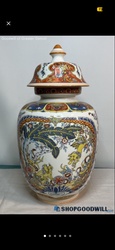
This is a Khokhloma painted lidded jar, likely made of wood, showcasing the characteristic vibrant folk art style from Russia. The jar has a gently curving, somewhat cylindrical body that tapers slightly towards the bottom and a fitted lid with a small, dark finial. The primary colors are a rich, glossy black background, contrasted with intricate patterns in gold and vivid red. The decoration primarily features large, stylized floral and leafy motifs. Golden leaves, often outlined in fine black lines, dominate the design, interspersed with flourishes and smaller details in bright red, suggesting berries or smaller flowers. A distinct red band encircles the rim below the lid, adding to the visual appeal. The lid itself is also decorated with the same colors, featuring smaller floral elements and leaves on a gold background, with a red trim along its edge. The overall finish appears shiny and lacquered, which is typical for Khokhloma ware, providing both protection and enhancing the colors. There are no visible major cracks, chips, or significant paint loss from the images, suggesting good general condition. The craftsmanship appears to be of decent quality, with the painted details being relatively clear and well-executed, consistent with traditional Russian folk art. Given the 'Made in USSR' context, this piece likely dates from the mid to late 20th century, a period when Khokhloma production was significant.
AI Appraisal Report
Based on my visual examination of the provided image, this Khokhloma painted lidded jar exhibits the distinctive characteristics of traditional Russian folk art. The primary colors of black, gold, and red, along with the stylized floral and leafy motifs, are consistent with Khokhloma craftsmanship. The glossy, lacquered finish appears intact, and I observe no significant cracks, chips, or major paint loss, suggesting it is in good general condition. The 'Made in USSR' designation dates this piece to the mid to late 20th century, a period of prolific Khokhloma production.
In terms of market conditions, Khokhloma ware, while aesthetically pleasing, is relatively common from the Soviet era. Demand is moderate, typically appealing to collectors of Russian folk art or decorative items. Rarity is not a significant factor for this type of item. The craftsmanship appears decent for mass-produced folk art, but it doesn't present the exceptional detail or artistic uniqueness that would command a premium.
Factors impacting value include its good condition and the inherent charm of the hand-painted decor. However, its commonality and typical production quality limit its value. For full authentication and to detect any potential restorations or material anomalies, a physical inspection would be essential. I would also seek provenance documentation, such as original purchase receipts or certificates, to confirm its origins definitively, as images alone cannot verify every aspect of authenticity.