These notes were written by the person who submitted this item. Appraiser.AI has not verified them, and the AI's identification and estimate may rely on them.
AI Estimated Value
Not an official valuation
$15-30
AI estimate as of August 26, 2025 · verify with a professional before acting
AI-Generated · Verify before acting
Everything on this page is generated by AI for informational purposes only. AI can make mistakes — the AI may misidentify items or misattribute them (artist, maker, brand, designer, origin, era). This is not an official valuation and should not be used for insurance, sale, tax, estate, legal, or lending purposes — or any decision requiring a certified appraisal. It is not an authoritative claim about any person, brand, or rights holder — do not share or rely on it as a factual statement about a third party. Always consult qualified professionals before making financial decisions.
This analysis also relies on unverified notes provided by the user, which may be incomplete or inaccurate and could affect the result.
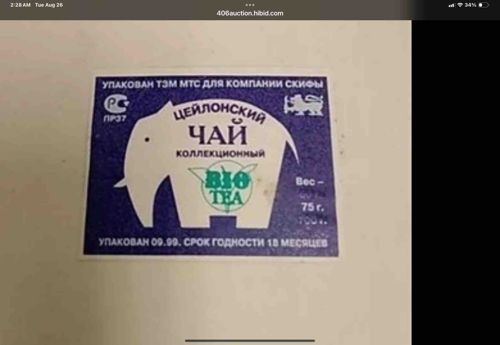
This item is a vintage tea packaging label, likely from a tea box or packet, featuring a prominent graphic of a white elephant against a dark blue background. The label is rectangular in shape and appears to be made of paper or light cardboard. The main text, in Cyrillic script, reads "ЦЕЙЛОНСКИЙ ЧАЙ КОЛЛЕКЦИОННЫЙ" (Ceylonskiy Chai Kollektsionnyy), which translates to "Ceylon Tea Collection." Another notable graphic is a stylized green 'BIO TEA' logo within the elephant's body. In the upper right corner, there's a small depiction of a lion with a sword, which is the national emblem of Sri Lanka (formerly Ceylon), indicating the origin of the tea. The bottom of the label includes manufacturing details, also in Cyrillic. 'УПАКОВАН 09.99.' suggests a packaging date of September 1999, and 'СРОК ГОДНОСТИ 18 МЕСЯЦЕВ' indicates an 18-month shelf life. 'БЕС - 75 г.' likely refers to the weight, 75 grams. There's also a 'РСТ' mark, a Russian conformity mark for product quality and safety. The overall condition shows some visible wear, including minor scuffs and slight discoloration, consistent with its age and being a piece of vintage paper ephemera. The colors are still relatively vibrant despite the age. The craftsmanship is typical of mass-produced food packaging from the late 20th century. Given the 'Made in India' context provided separately, it's interesting to note that while the tea is 'Ceylon' (Sri Lankan), the packaging or possibly the product's final assembly might have occurred in India, catering to a Russian-speaking market.
AI Appraisal Report
I have thoroughly examined the provided image of the Vintage Ceylon Tea Packaging Label, described as being from the Russian market and 'Made in India.'
Visually, the label appears authentic to its stated origin and period. The Cyrillic text, 'ЦЕЙЛОНСКИЙ ЧАЙ КОЛЛЕКЦИОННЫЙ,' the specific packaging date ('09.99.'), shelf-life ('18 МЕСЯЦЕВ'), weight ('75 г.'), and the 'РСТ' mark all align with late 20th-century Russian market food packaging ephemera. The white elephant graphic, 'BIO TEA' logo, and Sri Lankan lion emblem are consistent with tea branding of the era. The ‘Made in India’ detail, while initially counter-intuitive for Ceylon tea, is plausible for a product assembled or packaged in India for export to Russia, leveraging the global tea trade routes and manufacturing hubs.
Condition-wise, the label exhibits minor scuffs, slight discoloration, and general wear commensurate with its age and material (paper/light cardboard). The colors remain relatively vibrant, which is positive. This condition is typical for a vintage paper item that was part of mass-produced packaging.
Market conditions for vintage food packaging labels are generally niche. While not as sought after as fine art or rare stamps, unique designs, cultural significance, and good condition can drive modest interest. Comparables are primarily found within online ephemera sales or specialized antique paper dealers. Rarity for a mass-produced item like this is low, but its specific Russian market context and 'Ceylon Tea' origin add a layer of collecting appeal. Demand is limited to collectors of tea ephemera, Russian advertising, or packaging design.
Factors impacting value include its good, though not perfect, preservation, its specific geopolitical context (India-Russia-Sri Lanka connection), and its illustrative graphic design. However, its mass-produced nature and the general abundance of similar items prevent it from achieving high values.
My primary limitation in full authentication is the lack of physical inspection. I cannot assess paper degradation, ink quality, or detect subtle signs of reproduction without handling the item. In-person examination would involve scrutinizing paper texture, watermarks (if any), printing methods, and odor. Provenance documentation, such as where it was acquired or its history of ownership, would also bolster authenticity. Scientific testing, like ink analysis, would be an extreme measure for such an item, usually reserved for higher-value pieces.