AI estimate as of July 13, 2025 · verify with a professional before acting
AI-Generated · Verify before acting
Everything on this page is generated by AI for informational purposes only. AI can make mistakes — the AI may misidentify items or misattribute them (artist, maker, brand, designer, origin, era). This is not an official valuation and should not be used for insurance, sale, tax, estate, legal, or lending purposes — or any decision requiring a certified appraisal. It is not an authoritative claim about any person, brand, or rights holder — do not share or rely on it as a factual statement about a third party. Always consult qualified professionals before making financial decisions.
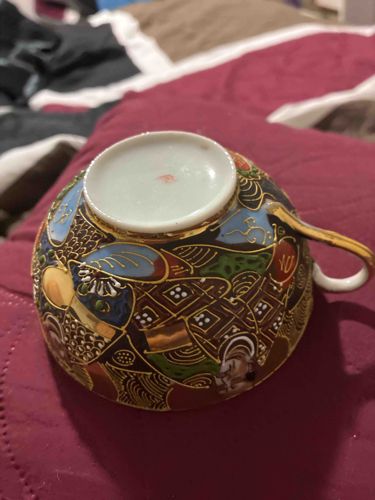
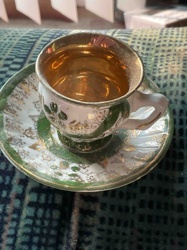
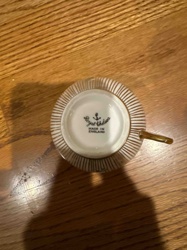
This is a meticulously decorated Japanese porcelain teacup, likely a demitasse cup given its relatively small size hinted by the handle's proportion. The cup features extremely detailed and vibrant enamel work, often referred to as 'Satsuma-style' or part of the Kutani ware tradition due to the rich color palette and extensive gilding. The exterior is adorned with a complex pattern composed of various geometric motifs and stylized elements, including what appears to be intricate karakusa (vine patterns), brocade designs, and perhaps sections depicting landscapes or figures, though the resolution limits precise identification of the latter. The color scheme is dominated by rich earth tones like brown, dark green, and deep red, contrasted with bright accents of blue, yellow, and a considerable amount of gold gilding that outlines and highlights almost every design element. The gold lines are precisely applied, indicating skilled craftsmanship. The handle is a simple 'C' shape, also likely gilded. The rim of the cup, not fully visible, would likely also feature a gold band. The base of the cup, which is shown inverted, is white and unglazed, revealing the porcelain body. There is a small, faint red mark on the center of the base, possibly a manufacturer's or decorator's mark, though it is not clear enough for identification. The overall condition appears good, with no obvious chips, cracks, or significant losses to the enamel or gilding visible; however, some minor wear to the gilding is possible given its age. The item's dense and intricate decoration suggests an approximate age from the late 19th to early 20th century.
AI Appraisal Report
This meticulously decorated Japanese porcelain teacup, displaying characteristics often associated with 'Satsuma-style' or Kutani ware due to its rich color palette, extensive gilding, and intricate enamel work. The exterior boasts a complex design of geometric patterns, stylized elements, and potentially karakusa (vine patterns) and brocade motifs. The dominant colors include earth tones like brown, dark green, and deep red, accented by bright blues, yellows, and pervasive gold gilding. The handle is a simple 'C' shape, likely gilded, mirroring the expected gold band on the rim. The unglazed, white base reveals the porcelain body, with a faint red mark that could be a manufacturer's or decorator's stamp, although it remains illegible. The overall condition appears good, with no visible chips, cracks, or significant loss to the enamel or gilding. However, minor wear to the gilding is possible given its age. The density and intricacy of the decoration suggest a late 19th to early 20th-century origin. While the image indicates good condition, an in-person examination would be crucial to confirm the absence of hairline cracks, repairs, or subtle gilding wear not discernible virtually. Authentication of the maker’s mark, if present, would require clear photographic documentation or in-person inspection. Provenance documentation would further confirm authenticity and increase value. Given the detailed craftsmanship and apparent good condition, for a collector of Japanese porcelain this cup exhibits a desirable aesthetic. However, without a definitive maker’s mark or known artist, and considering the mass production of similar 'Satsuma-style' wares during this period, the value is primarily decorative rather than artistic or historical significance associated with masterworks. This piece would appeal to a collector looking for high-quality decorative Japanese porcelain.