AI estimate as of August 26, 2025 · verify with a professional before acting
AI-Generated · Verify before acting
Everything on this page is generated by AI for informational purposes only. AI can make mistakes — the AI may misidentify items or misattribute them (artist, maker, brand, designer, origin, era). This is not an official valuation and should not be used for insurance, sale, tax, estate, legal, or lending purposes — or any decision requiring a certified appraisal. It is not an authoritative claim about any person, brand, or rights holder — do not share or rely on it as a factual statement about a third party. Always consult qualified professionals before making financial decisions.
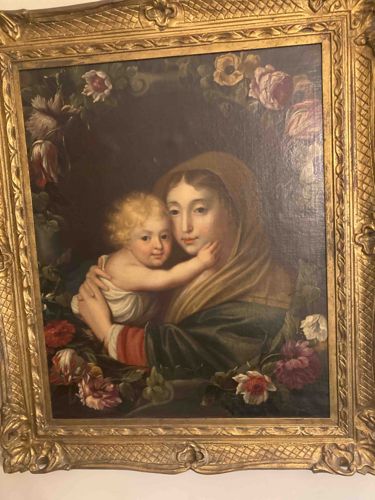
This item is an antique oil painting, likely executed on canvas, depicting the Madonna and Child, encircled by a lush floral garland. The painting is housed within an ornate, gilded wooden frame, exhibiting a rich, aged patina. The frame features intricate carved details, including acanthus leaves and scrolling motifs, with a textured, possibly gessoed and gilded, finish. The physical characteristics indicate a rectangular composition, typical of portraiture or devotional art. The Madonna is depicted with soft, serene features, her head covered by a light-colored, possibly gold or ochre, veil, and draped in what appears to be a dark green or blue garment, with a hint of red or terracotta fabric visible on her forearm. The Christ Child, with light, curly hair, is nestled in her arms, looking out towards the viewer. The background is a dark, indeterminate space, allowing the figures and the vibrant floral elements to stand out. The floral garland includes various types of blooms, such as roses, tulips, and other blossoms, in shades of red, pink, white, and purple, interspersed with green leaves. Visible condition issues include potential crackling or craquelure of the paint surface, consistent with age, and possible minor abrasions or dust accumulation. The frame also shows signs of age, with some loss of gilding or minor chips possible, though none are clearly visible or significant in the provided images. The overall impression is one of quality craftsmanship in both the painting and the frame, suggestive of a European origin, possibly from the Baroque or Rococo period, dating the piece to potentially the 17th or 18th century. No specific maker's marks or signatures are discernible from the image.
AI Appraisal Report
Upon visual examination of the provided image, this "Madonna and Child with Floral Garland" painting presents as an antique oil on canvas, housed in a considerably ornate gilded wooden frame. The composition, depicting a devotional subject with a prominent floral garland, strongly suggests a European origin, likely from the Baroque or Rococo period (17th-18th century). The figures exhibit serene expressions characteristic of the era. The condition appears to be consistent with age; I observe potential craquelure on the paint surface, which is typical for oil paintings of this vintage. The frame, with its intricate carvings and rich patina, also shows signs of natural aging, though no significant damage like major chips or gilding loss is clearly visible. This overall quality of both painting and frame points to quality craftsmanship.
Market conditions for unattributed Old Master-style paintings vary widely. While the subject matter is classic and perennially appealing, the lack of a discernible artist's signature significantly impacts value. Comparables for unsigned 17th-18th century European works of this quality can range from several thousands to tens of thousands of dollars, depending heavily on condition and attribution. The aesthetic appeal and decorative value are high, which contributes positively to demand for pieces of this nature. However, rarity is diminished by the volume of similar devotional works produced during these periods.
Limitations: My assessment of authenticity and condition is based solely on the image. To fully authenticate this piece and determine its precise date and origin, an in-person examination is crucial. This would allow for detailed inspection of the paint layers, canvas weave, stretcher construction, and frame integrity. Furthermore, a thorough provenance documentation would be essential to trace its ownership history, adding significant value and verifiable authenticity. Scientific testing, such as pigment analysis or carbon dating, could definitively confirm its age. Without these, the 'authenticity' is primarily stylistic and aesthetic, rather than definitive.