These notes were written by the person who submitted this item. Appraiser.AI has not verified them, and the AI's identification and estimate may rely on them.
AI Estimated Value
Not an official valuation
$150-250
AI estimate as of August 19, 2025 · verify with a professional before acting
AI-Generated · Verify before acting
Everything on this page is generated by AI for informational purposes only. AI can make mistakes — the AI may misidentify items or misattribute them (artist, maker, brand, designer, origin, era). This is not an official valuation and should not be used for insurance, sale, tax, estate, legal, or lending purposes — or any decision requiring a certified appraisal. It is not an authoritative claim about any person, brand, or rights holder — do not share or rely on it as a factual statement about a third party. Always consult qualified professionals before making financial decisions.
This analysis also relies on unverified notes provided by the user, which may be incomplete or inaccurate and could affect the result.
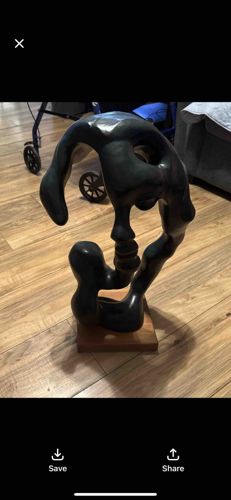
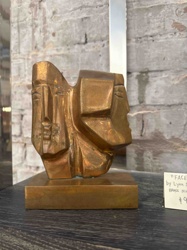
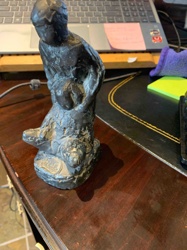
This item is an abstract, dark-colored sculpture, likely made of patinated metal (such as bronze or a resin casting with a metallic finish) or a similar dense material, mounted on a wooden base. The sculpture possesses a smooth, organic, and highly fluid form, characterized by curved lines and interconnected shapes that evoke a sense of continuous motion and human-like figures in an embrace or interaction. The dark, possibly bronze-like, finish appears to have a subtle sheen, suggesting a polished or patinated surface. There are no readily visible sharp edges; all forms are rounded and softened. The overall construction appears solid and well-executed, indicative of professional craftsmanship. The base is a rectangular block of light-to-medium toned wood, which provides stability and contrasts visually with the dark sculpture. There are no obvious signs of significant damage such as chips, cracks, or deep scratches on the main sculptural body, though the patina's consistency and any minor surface wear cannot be fully assessed without closer inspection. The overall aesthetic suggests a contemporary or modern art piece. The provided context 'Austin Sculptor 1985' likely refers to the manufacturer or artist (Austin Productions) and the year of creation, suggesting a vintage rather than antique piece.
AI Appraisal Report
Upon examining the provided image and information regarding this abstract figural sculpture attributed to "Austin Sculptor 1985" (likely Austin Productions, 1985), I can offer the following appraisal. The sculpture presents in what appears to be good overall condition. Its dark, patinated surface and smooth, fluid forms are characteristic of Austin Productions' aesthetic from that era, often utilizing Durastone (a composite material) with a bronze-like finish. Authenticity, based solely on visual cues and the provided 'Austin Sculptor 1985' notation, seems plausible for an Austin Productions piece. However, without a physical inspection for marks, signatures, or specific material analysis, definitive authentication beyond attribution cannot be made. The absence of visible chips, cracks, or significant abrasions suggests careful handling, though minor surface wear or patina inconsistencies would require in-person examination.
Austin Productions items from the 1980s are generally considered decorative art rather than fine art, which impacts their market value. They were mass-produced, limiting rarity. Demand is steady among collectors of vintage decorative art and those seeking mid-century/modern accent pieces, but it's not high. Comparable sales for similar Austin Productions sculptures in good condition typically range from $100 to $300. Factors influencing value include the specific design, size (which is hard to gauge precisely from the image), and the actual material (e.g., if it were solid bronze rather than Durastone, the value would be significantly higher, which is highly unlikely for Austin Productions). To fully verify authenticity and material, a physical examination for any manufacturer's marks, a 'thumb test' for material sound, and potentially provenance documentation (original sales receipts, catalogs) would be ideal. Given the information, this is a well-preserved decorative piece typical of its manufacturer and era.