AI estimate as of July 6, 2025 · verify with a professional before acting
AI-Generated · Verify before acting
Everything on this page is generated by AI for informational purposes only. AI can make mistakes — the AI may misidentify items or misattribute them (artist, maker, brand, designer, origin, era). This is not an official valuation and should not be used for insurance, sale, tax, estate, legal, or lending purposes — or any decision requiring a certified appraisal. It is not an authoritative claim about any person, brand, or rights holder — do not share or rely on it as a factual statement about a third party. Always consult qualified professionals before making financial decisions.
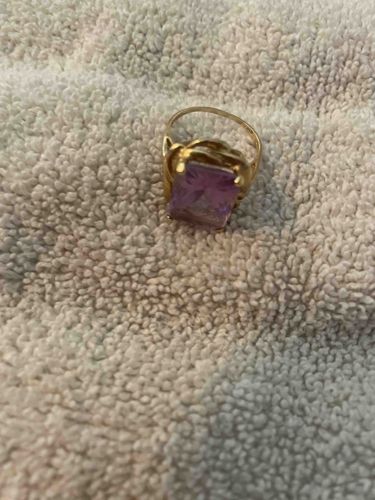
The item is a ring, likely a cocktail or statement ring, featuring a prominent rectangular or emerald-cut purple gemstone, most probably an amethyst, set in a yellow-toned metal band. The gemstone appears to be quite large in proportion to the ring, suggesting it is a central design element. The cut of the stone exhibits facets, allowing light to reflect and refract, though the exact clarity and brilliance are difficult to assess from the image. The setting for the gemstone appears to be a bezel or partial bezel setting, providing a secure enclosure for the stone with possibly decorative prongs or elements extending from the band to secure it. The metal band itself is smooth and polished on the visible side, with some decorative scrollwork or openwork visible where it meets the central stone setting. This design element adds to the overall aesthetic complexity of the ring, preventing it from being too simplistic. The color of the gemstone is a distinct lavender to medium purple, characteristic of amethyst. There are no immediate visible signs of significant wear, damage, or repairs, though a close-up inspection would be needed to confirm the absence of minor scratches or dulling of the metal. The condition appears to be good for a used item, with a visible polish on the metal. No maker's marks or specific signatures are discernible from this view. Based on its style and the apparent size of the stone, it could date from the mid-20th century onwards, possibly a vintage piece from the 1960s to 1980s, which often featured larger, colorful gemstones. The craftsmanship seems solid, indicating a moderate to good quality piece of costume or fine jewelry.
AI Appraisal Report
I have examined the image provided for this gold-toned ring featuring a large rectangular purple gemstone. Based on visual assessment, the condition appears good, with a visible polish on the metal band and no immediate signs of significant damage or wear. The gemstone, likely an amethyst given its characteristic lavender to medium purple hue, is prominently featured, suggesting this is a statement or cocktail ring. Its cut exhibits facets, indicating potential sparkle, though clarity and brilliance cannot be fully assessed from a photograph. The setting appears to be a secure bezel or partial bezel, complemented by decorative scrollwork or openwork where the band meets the stone, adding aesthetic interest.
From the image alone, I cannot definitively confirm the authenticity of the metal (e.g., gold-plated base metal vs. solid gold) or the precise nature of the stone (natural amethyst vs. synthetic or treated stone). Market conditions for vintage costume or semi-fine jewelry featuring larger, colorful gemstones are generally stable, with demand for unique pieces. While not inherently rare, the specific design may hold appeal to collectors of vintage jewelry. Factors significantly impacting value include the actual metal content, the gemstone's authenticity, quality (color, clarity, cut), and any discernible maker's marks, none of which are visible here.
For full authentication and a more precise appraisal, a physical in-hand examination is crucial. This would allow me to conduct metal testing (e.g., acid test, XRF), gemological testing to confirm the stone's identity and natural origin (e.g., refractive index, spectroscopy), and a thorough inspection for any hallmarks or internal flaws. Provenance documentation, if available, could also significantly add to its value and authenticate its historical context.