AI estimate as of December 16, 2025 · verify with a professional before acting
AI-Generated · Verify before acting
Everything on this page is generated by AI for informational purposes only. AI can make mistakes — the AI may misidentify items or misattribute them (artist, maker, brand, designer, origin, era). This is not an official valuation and should not be used for insurance, sale, tax, estate, legal, or lending purposes — or any decision requiring a certified appraisal. It is not an authoritative claim about any person, brand, or rights holder — do not share or rely on it as a factual statement about a third party. Always consult qualified professionals before making financial decisions.
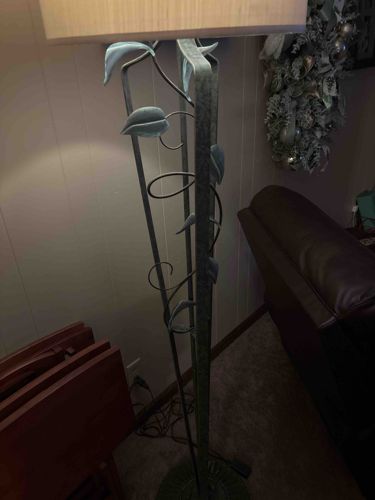
This is a floor lamp characterized by an elegant Art Nouveau-inspired design, featuring a botanical motif. The lamp stands tall with a central stem, likely crafted from metal, possibly wrought iron or a similar alloy, given its dark, somewhat textured appearance. The finish on the stem appears to be a muted dark green or bronze with lighter blue-green accents, suggesting a patina or painted effect to resemble aged metal or oxidized copper. Numerous curved metal elements, reminiscent of vines or tendrils, spiral around and extend from the central stem. Integrated throughout these 'vines' are sculpted metal leaves, which appear to be painted in a lighter, almost pastel blue-green color, creating a striking contrast with the darker stem. Some of these leaves exhibit subtle veining, enhancing their organic feel. The base of the lamp, partially visible, appears round and solid, featuring a relief pattern that continues the botanical theme, possibly resembling foliage or root structures. The lamp is topped with a simple, rectangular fabric lampshade, likely in an off-white, cream, or light tan color, providing a soft ambient light when illuminated. There are no clear markings or signatures visible in the provided image. The overall craftsmanship suggests a decorative piece, likely from the late 20th or early 21st century, designed to evoke the aesthetic of early 20th-century Art Nouveau art and design. The condition seems good, with no apparent major damage, though the exact nature of the patina and any minor wear would require closer inspection. The electrical cord is visible, indicating it is a functional, powered lamp.
AI Appraisal Report
I have examined the provided image of this Art Nouveau Style Floor Lamp with Botanical Motif. The lamp presents a well-executed decorative piece, likely a modern homage to the Art Nouveau era rather than an original antique. The central stem and spiraling tendrils with sculpted leaves, finished in a dark green/bronze and lighter blue-green, effectively capture the curvilinear and organic aesthetic of the style. The visible section of the base also continues this botanical theme. The rectangular fabric lampshade is simple and functional, appropriate for the style. My assessment of its condition, based solely on the image, is good, showing no obvious signs of major damage or repair, though minor surface wear or inconsistencies in the patina would require in-person inspection. The electrical cord suggests it is a fully functional unit. While the design is compelling, the absence of clear markings, the slightly 'new' appearance despite the patina effect, and the stylistic elements suggest a late 20th to early 21st-century production. True Art Nouveau pieces from the early 20th century, particularly those by renowned designers or manufacturers, command significantly higher values due to rarity, craftsmanship, and historical significance. Current market conditions for reproduction or style-inspired decorative lighting are stable, with demand for well-designed pieces. Comparables would include high-end reproduction lighting or lamps from design-focused retailers. Factors impacting value are primarily its decorative appeal and good condition. For full authentication regarding its age and origin, a physical examination would be crucial to inspect metal composition, construction techniques (e.g., welds, joinery), internal wiring components, and to search for any hidden manufacturer marks. Provenance documentation would also greatly assist in verifying its history. Without such an in-person assessment, I must appraise this as a decorative, Art Nouveau-style floor lamp.