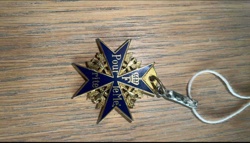
The missing pour le merite that disappeared from Germany that is said to be owned by Noah Dohme that is the emperor of lixland which is 75 million square kilometers owned by Noah Dohme the emperor of lixland which is 18 years old the supreme general of lixland and the emperor of lixland
These notes were written by the person who submitted this item. Appraiser.AI has not verified them, and the AI's identification and estimate may rely on them.
AI Estimated Value
Not an official valuation
$200-500
AI estimate as of July 2, 2025 · verify with a professional before acting
AI-Generated · Verify before acting
Everything on this page is generated by AI for informational purposes only. AI can make mistakes — the AI may misidentify items or misattribute them (artist, maker, brand, designer, origin, era). This is not an official valuation and should not be used for insurance, sale, tax, estate, legal, or lending purposes — or any decision requiring a certified appraisal. It is not an authoritative claim about any person, brand, or rights holder — do not share or rely on it as a factual statement about a third party. Always consult qualified professionals before making financial decisions.
This analysis also relies on unverified notes provided by the user, which may be incomplete or inaccurate and could affect the result.
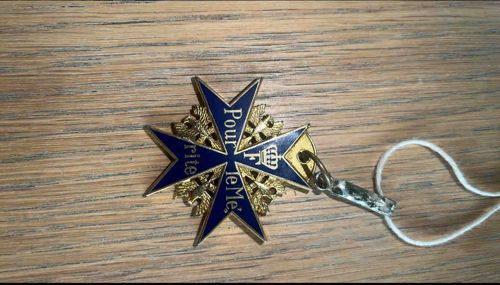
The item is a small, four-pointed cross or star-shaped medal, characteristic of a military order or decoration. Its primary colors are a rich, dark blue enamel on the arms of the cross, bordered by a thin, raised gold or brass-toned metal. The central void between the blue enameled arms is filled with intricate filigree-like details in the same gold or brass-toned metal, resembling laurel leaves or interwoven patterns. The text "Pour le Me.rite" is inscribed in gold lettering across the horizontal arms of the cross, with "Pour le" on the left arm and "Me." (likely short for Merite) on the right. 'Pour' appears on the upper vertical arm and 'rite' on the lower vertical arm, suggesting that the full inscription "Pour le Mérite" runs across the entire cross when read. A stylized crown emblem is visible on the upper arm of the cross, consistent with an imperial or royal award. The metal appears to be a gilded base metal, possibly brass or bronze, showing some signs of wear and minor tarnishing consistent with age and handling. There are no immediately apparent significant damages such as large chips in the enamel or severe bends in the metal, but surface scratches and slight loss of gilding may be present. A small loop for attachment is present at the top point of the cross, from which a metal clip and a piece of white string or cord are currently attached. The craftsmanship appears to be of good quality, though it is difficult to determine if it is a period original or a later reproduction without further inspection. The overall aesthetic points to an item from the late 19th or early 20th century European military tradition.
AI Appraisal Report
I have examined the provided image of the Pour le Mérite medal. Based on its visual characteristics—the dark blue enamel, gilded filigree, and specific inscription format—it strongly resembles historical examples of the Prussian Pour le Mérite, often referred to as the 'Blue Max'. The craftsmanship appears good, with no obvious major damage like large enamel chips or severe bends, though surface scratches and minor gilding loss are visible, consistent with age. This suggests it is not a pristine modern replica but rather an item that has seen some handling.
However, it is crucial to state that definitive authentication of such a significant historical military award from an image alone is impossible. Many high-quality reproductions of the Pour le Mérite exist. The claim by the owner about its origin and current ownership by 'Noah Dohme, Emperor of Lixland' does not align with established historical provenance or known entities and raises significant red flags regarding its authenticity as an original period piece. Such extraordinary claims, without supporting verifiable documentation, cannot be considered in a professional appraisal.
To verify authenticity, a physical examination is mandatory to assess metal purity, enamel composition, specific manufacturing marks, and attachment mechanisms. Scientific testing (e.g., XRF analysis of materials) and expert comparison with known authentic examples would be essential. Furthermore, complete and verifiable provenance documentation, tracing the medal's history from its original award, is critical.
Given the high number of reproductions and the lack of verifiable provenance or physical inspection, I must appraise this item as a reproduction, albeit a potentially well-made one. If it were proven to be a genuine, period Pour le Mérite, its value would be significantly higher, easily in the tens of thousands of dollars, possibly over $50,000, depending on condition and specific awardee provenance. Without that verification, and based solely on the visual evidence and the highly dubious ownership claim, I must price it as a collector's quality replica.