AI estimate as of September 29, 2025 · verify with a professional before acting
AI-Generated · Verify before acting
Everything on this page is generated by AI for informational purposes only. AI can make mistakes — the AI may misidentify items or misattribute them (artist, maker, brand, designer, origin, era). This is not an official valuation and should not be used for insurance, sale, tax, estate, legal, or lending purposes — or any decision requiring a certified appraisal. It is not an authoritative claim about any person, brand, or rights holder — do not share or rely on it as a factual statement about a third party. Always consult qualified professionals before making financial decisions.
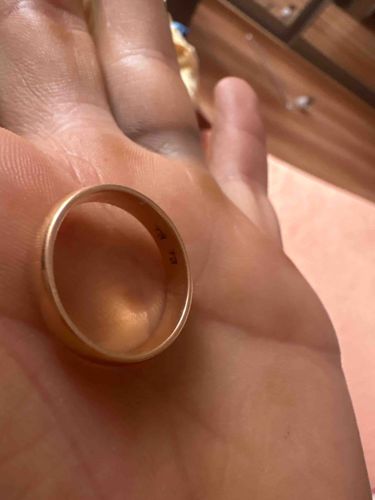
This item is a classic gold wedding band, prominently displayed in the palm of a hand. The ring appears to be crafted from yellow gold, exhibiting a warm, lustrous golden hue. It features a traditional, plain D-shaped profile with a domed exterior surface and a flat inner surface, often referred to as a comfort-fit band. The width of the band appears to be moderate, likely between 4mm and 6mm based on its proportion to the fingers in the image. There are visible inscribed markings on the inner surface of the band, though the exact characters are difficult to discern clearly from the provided image. They resemble a combination of letters and numbers, possibly 'KA 73' or similar, which could indicate a maker's mark, a purity stamp (e.g., karatage), or an engraving. The ring shows a generally good, polished finish, with some minor surface wear consistent with regular use, such as hairline scratches or micro-abrasions that are common in worn jewelry but no significant deep scratches or dents are observable. The overall condition suggests it is a well-maintained piece. Given its simple yet elegant design, it likely dates from the mid-20th century to contemporary times, as this style remains timeless. The craftsmanship appears to be solid and functional, characteristic of a well-made piece of everyday jewelry. Its classic form factor makes it a staple in bridal or commemorative jewelry.
AI Appraisal Report
Based on my visual examination of the provided image, this is a classic yellow gold wedding band. It presents with a traditional D-shaped profile, indicative of a comfort-fit design, with a moderate width likely between 4mm and 6mm. The warm golden hue suggests it is crafted from a standard karat gold, most commonly 10K, 14K, or 18K. The finish is well-polished, exhibiting minor surface wear consistent with regular use, such as hairline scratches, but no significant damage like deep dents or scratches. This indicates it is a well-maintained piece in good condition.
Market conditions for plain gold bands are relatively stable, driven primarily by the current price of gold by weight and the karat purity. Comparables for new D-shaped comfort-fit bands of similar dimensions typically range from $400 to $800, depending heavily on the precise gold content and brand. Given this is a pre-owned item, a deduction is applied to account for the secondary market. Demand for such timeless pieces remains consistent, as they are staple items. Rarity is not a factor here; this is a very common style.
Factors significantly impacting value include the actual karat purity of the gold (e.g., 10K, 14K, 18K, 22K) and its precise weight, neither of which can be determined from an image alone. The inscribed markings 'KA 73' or similar are visible; these could be a maker's mark or a purity stamp, but without clearer resolution, their exact meaning or authenticity cannot be verified.
Limitations in authenticity verification are significant. From the image alone, I cannot definitively confirm the gold purity, the precise weight, or even absolute authenticity of the metal content. For full authentication and a more precise valuation, an in-person examination would be crucial to physically assess the purity stamp, measure the weight, and conduct gold testing if necessary. Provenance documentation, though unlikely for a simple band, could also offer historical context.