AI estimate as of November 10, 2025 · verify with a professional before acting
AI-Generated · Verify before acting
Everything on this page is generated by AI for informational purposes only. AI can make mistakes — the AI may misidentify items or misattribute them (artist, maker, brand, designer, origin, era). This is not an official valuation and should not be used for insurance, sale, tax, estate, legal, or lending purposes — or any decision requiring a certified appraisal. It is not an authoritative claim about any person, brand, or rights holder — do not share or rely on it as a factual statement about a third party. Always consult qualified professionals before making financial decisions.
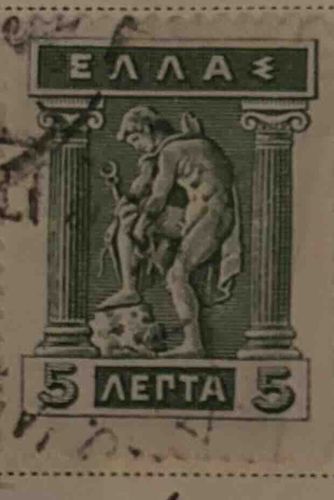
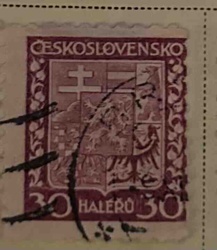
This item is a vintage Greek postage stamp, denominated at 5 Lepta, featuring a classical depiction of the Greek god Hermes. The stamp is printed in a dark green ink on what appears to be off-white or cream-colored paper. The design is framed by two ornate pillars in the Ionic or Corinthian style, supporting an architrave-like structure at the top. The upper section of the stamp clearly displays the Greek word 'ΕΛΛΑΣ' (ELLAS), meaning Greece, in bold, sans-serif capital letters. Below this, the central motif is a dynamically posed male figure, likely Hermes, depicted in classical Greco-Roman style. He is shown with a caduceus, his traditional staff, in his left hand, and appears to be leaning over or manipulating something at his feet, possibly a small animal or object, rendered in a somewhat abstract form. He has winged sandals, a characteristic attribute of Hermes. At the bottom of the stamp, the denomination '5' is prominently displayed on both the left and right sides, flanking the word 'ΛΕΠΤΑ' (LEPTA), signifying the currency unit. The stamp exhibits visible signs of age and wear. There are clear indications of perforation along all four edges, suggesting it was part of a larger sheet. A dark, possibly black, circular postmark is partially visible in the upper left quadrant, obscuring part of the 'ΕΛΛΑΣ' text and the top of the left pillar, indicating it has been used. The paper appears slightly discolored or toned with age, and there might be some minor creasing or handling marks, though these are not severe. The print quality appears generally good, with reasonable detail preserved in the engraving, despite the overall muted color palette. The style suggests it belongs to an early to mid-20th-century philatelic period, possibly pre-World War II, given the classical theme and printing method.
AI Appraisal Report
This Greek 5 Lepta Hermes postage stamp, printed in dark green, exhibits characteristic features of early Greek philately. Authenticity, based solely on the image, appears strong. The 'ΕΛΛΑΣ' text, Hermes depiction with caduceus and winged sandals, and '5 ΛΕΠΤΑ' denomination are consistent with known issues of this type from the early 20th century (likely Hermes Head series). Printing quality seems decent, preserving reasonable detail despite the age and wear. The most significant factor impacting value is its condition. The stamp displays clear signs of age, including discoloration, handling marks, and a prominent circular postmark partially obscuring the design and text. While a postmark confirms usage and can add historical context, this particular one is heavy and detracts visually. The visible perforations on all sides are a plus for a used stamp. Given the condition, it falls into the 'used' category with moderate flaws. Market conditions for common-denominated, used Greek stamps of this era are generally stable but not exceptionally strong, unless in superb condition or rare varieties. Comparables suggest similar used examples in fair-to-good condition typically range from a few dollars to modest double-digit figures. Demand for this specific stamp is moderate among general philatelists. The heavy postmark and general wear limit its appeal to serious collectors seeking pristine examples. For full authentication and to ascertain specific varieties (e.g., paper type, shade variations, printing errors), an in-person examination under magnification, assessment of gum (if applicable for unused), and comparison with known certified examples would be essential. Provenance documentation, though less common for individual stamps, would further solidify its history. Without physical inspection, I cannot rule out potential repairs or subtle alterations.