AI estimate as of December 10, 2025 · verify with a professional before acting
AI-Generated · Verify before acting
Everything on this page is generated by AI for informational purposes only. AI can make mistakes — the AI may misidentify items or misattribute them (artist, maker, brand, designer, origin, era). This is not an official valuation and should not be used for insurance, sale, tax, estate, legal, or lending purposes — or any decision requiring a certified appraisal. It is not an authoritative claim about any person, brand, or rights holder — do not share or rely on it as a factual statement about a third party. Always consult qualified professionals before making financial decisions.
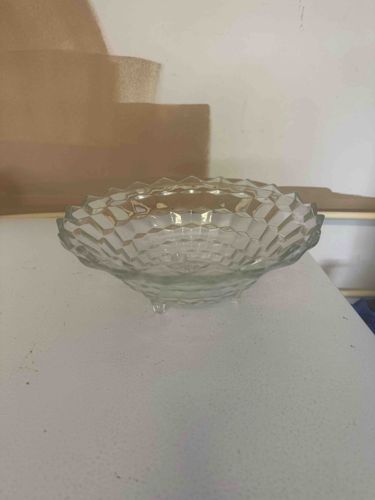
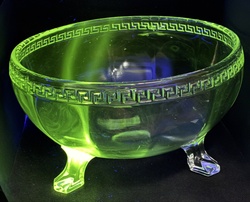
This item is a clear, colorless pressed glass bowl, characterized by a distinct hexagonal, honeycomb-like pattern covering its exterior surface, from the rim down to the base. The bowl has a shallow, circular form with an undulating or scalloped rim that follows the peaks and valleys of inner hexagonal facets. It stands on three small, rounded feet, which appear to be integrally molded into the base of the bowl. The overall construction suggests it was manufactured through a pressing process, where molten glass is pressed into a mold, creating a uniform pattern and shape. The clarity of the glass indicates a relatively good quality of material, free from significant opacities or air bubbles that would suggest lower-grade glass. There are no visible maker's marks, signatures, or stamps evident from the provided images, which is common for many pressed glass items. The style, with its geometric patterning and footed design, is typical of mid-20th-century American pressed glass, possibly dating from the 1930s to the 1960s. The bowl appears to be in good condition, showing no obvious chips, cracks, or significant wear. The glass still exhibits good brilliance and transparency. Its craftsmanship, while mass-produced, shows a clean execution of the molded pattern, with no significant seams or rough edges visible.
AI Appraisal Report
Based on my visual examination of the provided images, this clear, colorless pressed glass hexagonal-patterned footed bowl appears to be in very good condition. I detect no obvious chips, cracks, significant wear, or cloudiness, which suggests it has been well-preserved. The clarity of the glass and clean execution of the molded pattern are consistent with good manufacturing quality for pressed glass of its era. The design, featuring a honeycomb pattern, scalloped rim, and three small rounded feet, is highly typical of American pressed glass produced from the 1930s to the 1960s. This style was mass-produced by numerous manufacturers during that period.
Authenticity, as a vintage pressed glass item, appears to be straightforward based on its common design elements and manufacturing techniques. However, without a physical inspection, I cannot confirm the absence of subtle flaws like minute scratches or shelf wear that might not be visible in photographs. The lack of a maker's mark, while common for this type of ware, prevents attribution to a specific manufacturer without further research into pattern identification.
Market conditions for common pressed glassware, regardless of its good condition, are generally soft. While there's a steady collector base for specific patterns or rare manufacturers, generic hexagonal patterns are abundant. Demand is moderate, primarily from decorators seeking vintage charm rather than serious collectors. Rarity is low; countless similar bowls were produced.
Factors impacting value positively are its excellent apparent condition and classic, versatile design. Negatively, its lack of identifiable provenance or maker, and its mass-produced nature, significantly limit its monetary value. A deeper dive into pressed glass pattern guides might identify a manufacturer, but it’s unlikely to dramatically increase value unless it connects to a highly desirable or rare pattern. An in-person examination would allow for a tactile assessment of condition, observation of glass quality under varying light, and a more thorough search for any faint marks or pattern details that could aid in specific identification.