AI estimate as of July 13, 2025 · verify with a professional before acting
AI-Generated · Verify before acting
Everything on this page is generated by AI for informational purposes only. AI can make mistakes — the AI may misidentify items or misattribute them (artist, maker, brand, designer, origin, era). This is not an official valuation and should not be used for insurance, sale, tax, estate, legal, or lending purposes — or any decision requiring a certified appraisal. It is not an authoritative claim about any person, brand, or rights holder — do not share or rely on it as a factual statement about a third party. Always consult qualified professionals before making financial decisions.
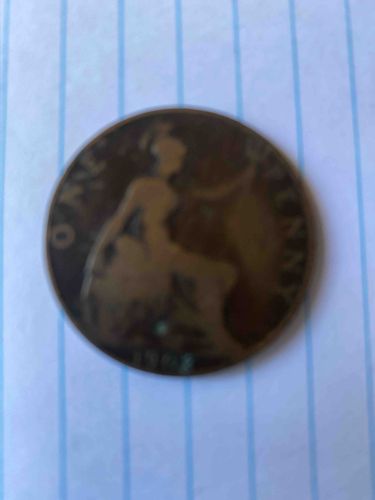
The item is a round copper or bronze coin, likely a British One Penny piece, based on the visible 'ONE' and 'PENNY' text and the iconic seated Britannia figure. The reverse side features the classic design of Britannia, personification of Great Britain, seated with a trident in one hand and a shield leaning against her. While specific details of Britannia's face and attire are somewhat obscured by wear and the image's focus, her general posture and attributes are discernible. The coin exhibits a dark brown patina, consistent with aged copper or bronze coinage. There are visible areas of what appears to be green verdigris, particularly around the lower central part of the coin, indicating environmental exposure and copper corrosion. The date, although blurred, appears to be '1908', which would place it within the reign of King Edward VII if it is indeed a British Penny. The edges appear smooth, though no reeding is clearly visible. The overall condition suggests circulation, with softened details from wear, and the presence of corrosion impacts its aesthetic quality. The craftsmanship is typical of mass-produced coinage from the early 20th century, with standard die-struck features. No specific mint marks are visible in the provided image.
AI Appraisal Report
Upon my examination of the provided image of what appears to be a 1908 British One Penny coin, my assessment of its condition is fair to good, with clear signs of significant circulation and environmental exposure. The coin exhibits softened details on both sides, particularly affecting the finer elements of Britannia and what I presume to be the monarch's portrait on the obverse. The dark brown patina is consistent with aged copper or bronze, but the presence of green verdigris, especially around the lower central area, indicates corrosion that negatively impacts its aesthetic appeal and preservation. Authenticity, based on visual cues such as the Britannia design and the partially discernible '1908' date, appears consistent with genuine British Penny coinage of the Edward VII era. However, without a physical inspection, I cannot rule out the possibility of a well-executed counterfeit, though the wear patterns suggest genuine age.
Market conditions for common date British Edward VII Pennies in this condition are generally modest. This specific year, 1908, is not considered rare. Comparables in similar circulated condition, especially with verdigris, typically fetch low prices. Demand for such a piece is primarily from beginner collectors or those seeking a type example. The significant factors impacting its value are the widespread circulation, the presence of visible corrosion, and the lack of any discernible special attributes (like a rare mint mark, which is not applicable to British pennies of this period anyway). The verdigris is particularly detrimental as it suggests active corrosion that can continue to degrade the coin.
For full authentication and a definitive appraisal, an in-person examination would be crucial. This would allow me to assess the coin's weight, diameter, thickness, and edge reeding (if applicable), all of which are vital for confirming authenticity. Furthermore, a direct view would permit a more thorough inspection of the surfaces for any signs of tooling, repairs, or more subtle counterfeiting indicators. Provenance documentation, such as records of prior ownership, would also bolster confidence in its history. Scientific testing, specifically X-ray fluorescence (XRF) for metallic composition, could confirm the alloy and rule out certain types of fakes. Without these, the appraisal remains an informed estimate based solely on the visual evidence provided.