AI estimate as of August 16, 2025 · verify with a professional before acting
AI-Generated · Verify before acting
Everything on this page is generated by AI for informational purposes only. AI can make mistakes — the AI may misidentify items or misattribute them (artist, maker, brand, designer, origin, era). This is not an official valuation and should not be used for insurance, sale, tax, estate, legal, or lending purposes — or any decision requiring a certified appraisal. It is not an authoritative claim about any person, brand, or rights holder — do not share or rely on it as a factual statement about a third party. Always consult qualified professionals before making financial decisions.
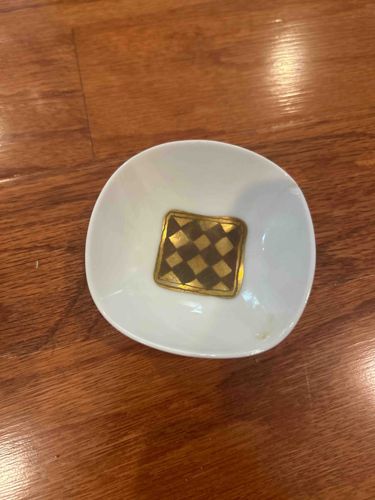
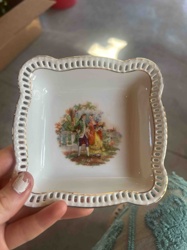
This item is a small, relatively shallow ceramic or porcelain dish, likely functioning as a ring dish, trinket dish, or perhaps an individual serving dish for condiments or nuts. It features an organic, slightly irregular round or gently squared shape with curved corners and smooth, subtly elevated sides, suggesting a contemporary or modernist aesthetic. The primary material appears to be a high-gloss white ceramic or porcelain, indicating a refined and elegant finish. The interior of the dish is adorned with a prominent raised, square-shaped insert crafted from what appears to be brass, gilded metal, or a similar reflective material, exhibiting a distinctive checkered pattern. This pattern consists of alternating squares of polished gold-tone and patinated or darker gold-tone, creating a visually appealing contrast. The metallic insert is securely embedded and follows the contours of the dish's bottom.
Visible condition issues include a subtle light brown stain or discoloration on the white ceramic near the rim, suggesting prior use or a minor blemish from manufacturing or handling. No significant chips, cracks, or repairs are immediately evident from the image, indicating generally good preservation. The craftsmanship appears to be of good quality, with smooth lines and a well-integrated metallic element. The absence of discernible maker's marks or signatures makes precise manufacturing details difficult to ascertain without further inspection. Based on its clean lines and minimalist yet decorative design, the piece likely dates from the mid-20th century onwards, possibly originating from a design-focused studio or manufacturer.
AI Appraisal Report
Upon examining the provided image of the White Ceramic Trinket Dish with Checkerboard Brass Insert, I assess its condition to be good overall. The high-gloss white ceramic exhibits clean lines and a refined finish. I've noted a subtle light brown stain or discoloration near the rim, which appears to be a minor blemish from either previous use or manufacturing. Crucially, I see no immediate evidence of chips, cracks, or repairs, indicating good preservation. The brass or gilded metal insert is well-integrated, and its checkerboard pattern presents an attractive visual contrast.
From a market perspective, pieces like this, with their clean lines and minimalist yet decorative design, align well with current trends for mid-century modern and contemporary decorative arts. While the absence of discernible maker's marks or signatures limits precise attribution, similar high-quality, design-focused trinket dishes and decorative bowls from anonymous or lesser-known studios typically fetch modest prices. Comparables in the online marketplace for similar ceramic and brass decorative items, particularly those without provenance, range from $30 to $100.
Demand for such decorative items remains steady, driven by interior design trends. However, without a known designer or manufacturer, its rarity is not particularly high, which affects its top-tier value potential. The primary factors impacting value here are its pleasing aesthetic, good condition (despite the minor stain), and versatility as a decorative object. The lack of identifiable provenance significantly limits its collectible value to what it is aesthetically worth as a decorative object.
It is imperative to state that this appraisal is based solely on visual examination of the provided image. Limitations in authenticity verification are inherent; I cannot confirm the exact material composition of the metallic insert (e.g., solid brass vs. plated), the absence of hairline cracks, or the precise nature of the stain without a physical in-person examination. For full authentication and a definitive assessment, I would require a direct physical inspection to thoroughly examine surfaces, check for hidden damage, and potentially conduct material testing. Provenance documentation, if available, would also be critical for establishing origin and a potential designer attribution, which could significantly increase its value.