These notes were written by the person who submitted this item. Appraiser.AI has not verified them, and the AI's identification and estimate may rely on them.
AI Estimated Value
Not an official valuation
$125-200
AI estimate as of August 24, 2025 · verify with a professional before acting
AI-Generated · Verify before acting
Everything on this page is generated by AI for informational purposes only. AI can make mistakes — the AI may misidentify items or misattribute them (artist, maker, brand, designer, origin, era). This is not an official valuation and should not be used for insurance, sale, tax, estate, legal, or lending purposes — or any decision requiring a certified appraisal. It is not an authoritative claim about any person, brand, or rights holder — do not share or rely on it as a factual statement about a third party. Always consult qualified professionals before making financial decisions.
This analysis also relies on unverified notes provided by the user, which may be incomplete or inaccurate and could affect the result.
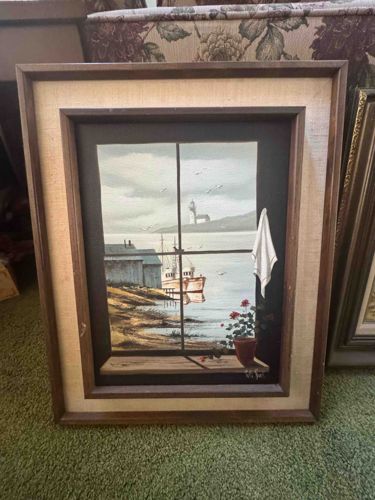
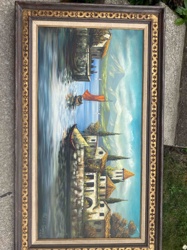
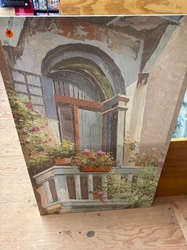
This item is a framed oil painting, likely on canvas or board, depicting a trompe l'oeil scene viewed through a window. The painting measures approximately 20-24 inches in height and 16-20 inches in width, including the frame. The frame itself is multi-layered, featuring an outer dark wooden molding, an inner lighter, possibly linen-wrapped or textured mat, and a thin dark wood fillet immediately bordering the artwork. The overall color palette is muted, with grays, blues, and browns dominating the seascape, contrasted by the green foliage and red flowers on the windowsill. The central scene portrays a harbor or coastal area with a fishing boat docked near a grey boathouse, a distant lighthouse on a hilly coastline, and seagulls flying in a cloudy sky. The 'window' itself has vertical and horizontal mullions painted into the artwork, creating a realistic depth illusion. On the right side of the window, a white cloth or towel is draped, while the bottom sill features a terracotta pot with vibrant red roses or similar flowers. The brushstrokes appear impressionistic, particularly in the water and sky, with thicker impasto visible in areas like the boat and buildings. There are no readily visible artist signatures, marks, or stamps from the provided image. The frame shows some minor wear, especially on the left side where a scuff or small chip is present on the dark wood portion. The fabric-like mat within the frame appears clean and intact. Based on the style and framing, the painting likely dates from the mid to late 20th century, possibly 1960s-1980s. The 'Good condition' indicates minimal significant damage beyond the noted frame superficialities, suggesting that the paint surface is largely free of cracks, chips, or discoloration.
AI Appraisal Report
Upon examining the images provided of this Framed Coastal Seascape Painting with Trompe L'oeil Window, I have conducted an appraisal based on its visual characteristics. The artwork is a competently executed oil painting, likely from the mid to late 20th century. Its style is decorative and impressionistic, with a clever use of trompe l'oeil to create the illusion of viewing a harbor scene through a window. The overall condition appears to be good, with stable paint and minimal surface issues. The multi-layered frame shows minor wear, such as a scuff on the left side, which is consistent with its age and does not significantly detract from its value.
The primary factor impacting the value is the lack of an artist's signature or any identifying marks. Anonymity places this piece in the category of decorative art, which has a broad but generally lower-value market compared to works by listed artists. The subject matter—a coastal seascape with a lighthouse and fishing boat—is classically popular and commercially appealing. However, similar unsigned decorative paintings of this era and quality are quite common.
Market comparables for unsigned 20th-century decorative paintings of this size and subject typically sell in the low to mid-hundreds. The trompe l'oeil element adds a degree of novelty that may increase its appeal slightly over a standard seascape. However, it's important to note the limitations of a digital-only appraisal. I cannot authenticate the medium, substrate, or age definitively without a physical inspection. A full authentication would require examining the back of the canvas or board, searching for hidden signatures under ultraviolet light, and reviewing any provenance documentation. Without this information, the painting is valued as a decorative work.