AI estimate as of July 10, 2025 · verify with a professional before acting
AI-Generated · Verify before acting
Everything on this page is generated by AI for informational purposes only. AI can make mistakes — the AI may misidentify items or misattribute them (artist, maker, brand, designer, origin, era). This is not an official valuation and should not be used for insurance, sale, tax, estate, legal, or lending purposes — or any decision requiring a certified appraisal. It is not an authoritative claim about any person, brand, or rights holder — do not share or rely on it as a factual statement about a third party. Always consult qualified professionals before making financial decisions.
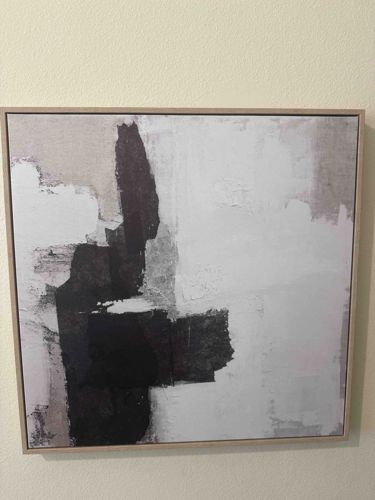
This is a framed abstract canvas print, predominantly featuring a monochromatic color palette of black, white, and various shades of grey. The composition is characterized by bold, seemingly brushed strokes and layered blocks of color, giving the appearance of texture and depth. Large areas of solid black forms dominate the left side, exhibiting a rough, almost distressed edge, consistent with an expressive, gestural style. Interspersed with and behind these black elements are areas of textured white and pale grey, suggesting underlying layers or washes. The right side of the canvas is largely white with subtle grey undertones and textural variations. The surface of the print shows visible texture, mimicking the impasto effect of original paintwork, suggesting it might be a giclée print or similarly high-quality reproduction on canvas. The item is housed within a simple, light-colored wooden or wood-look float frame, which leaves a visible gap between the canvas edge and the frame, enhancing the modern aesthetic. The condition appears very good, with no visible damage, tears, or significant wear. There are no discernible artist signatures, maker's marks, or dates visible in the provided image. The style aligns with contemporary abstract art, typical of pieces produced from the late 20th century to the present day, often used for modern interior design. The craftsmanship seems of typical production quality for decorative art pieces; while it replicates artistic brushwork, it is clearly a manufactured print rather than an original painting, indicated by the uniformity of the texture and lack of unique brushstroke variations found in an original artwork.
AI Appraisal Report
Upon examining the provided image of this Abstract Monochromatic Canvas Print in Float Frame, my assessment of its condition is very good. There are no visible blemishes, tears, or significant wear; the print appears well-maintained. Authenticity, however, is a key consideration here. Based on the uniform texture mimicking impasto and the lack of unique brushwork variations, this is clearly a manufactured print, likely a giclée or similar high-quality reproduction on canvas, rather than an original painting. This limits its value significantly. There are no discernible artist signatures, maker's marks, or dates, which further suggests it's a decorative mass-produced item rather than a unique artwork from a named artist.
Market conditions for this type of decorative abstract print are generally robust due to its versatility in modern interior design. Comparable items, typically sold through home decor retailers or large online art print vendors, range from $100 to $400 depending on size and specific retailer. Demand for such pieces is steady, driven by aesthetic appeal rather than artistic rarity. Rarity is not a factor here; these prints are produced in large quantities.
The primary factor impacting value is its status as a reproduction print rather than an original artwork. While the float frame adds a touch of modern appeal, it doesn't elevate the value substantially.
It is crucial to note the limitations of authenticity verification from images alone. A physical examination would allow me to inspect the canvas and print quality in detail, verify the texture, and conclusively determine if it's a print or a unique artwork. Provenance documentation (e.g., purchase receipts, artist's certificates) would be essential for authenticating an original artwork, which is absent here. Scientific testing (e.g., pigment analysis) would be overkill for a decorative print but necessary for a high-value original to confirm materials and age.