AI Appraisal Estimate

AI-generated estimates · not official valuations

From the user

What was submitted

Photo and notes provided by the user — not generated by AI

Submitted item photo
Submitted photo · May 18, 2026

User's notes

No additional notes provided.

AI analysis below

AI appraisal

AI analysis & estimate

AI-Generated · Verify before acting

Everything below is generated by AI for informational purposes only. AI can make mistakes — the AI may misidentify items or misattribute them (artist, maker, brand, designer, origin, era). This is not an official valuation and should not be used for insurance, sale, tax, estate, legal, or lending purposes — or any decision requiring a certified appraisal. It is not an authoritative claim about any person, brand, or rights holder — do not share or rely on it as a factual statement about a third party. Always consult qualified professionals before making financial decisions.

Read the full disclaimer

AI Identification

·Not independently authenticated·Verify before acting

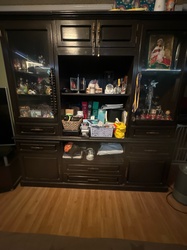
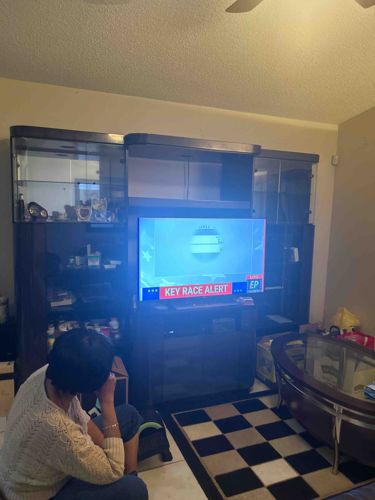
Mid-to-Late 20th Century Lacquered Wood Wall Unit Entertainment Center

Furniture - Entertainment Centers & Wall Units

AI Estimated Value

·Not an official valuation·Verify before acting

$400 - $700

As of May 18, 2026

AI Item Analysis

·AI can make mistakes·Verify before acting
This is a large, three-section modular wall unit entertainment center, characteristic of mid-to-late 20th-century design, approximately the late 1980s or 1990s. The piece features a dark, likely espresso or mahogany-colored lacquered wood finish with a high-gloss sheen. The construction includes a central television niche, which currently houses a flat-screen television, flanked by two taller side cabinets. Each side cabinet features glass-fronted upper display areas with mirrored backs and glass shelving, designed for highlighting decorative objects through integrated puck lighting (visible at the top). The lower portions of the side units appear to contain solid cabinet doors or drawers for concealed storage. A notable design element is the rounded, waterfall-style edges on the vertical outer corners and the crown molding, which gives the piece a softened, post-modern aesthetic. The material is likely a combination of wood solids and veneers over particle board or MDF, typical of mass-produced furniture from this period. Notable features include the integrated bridge connecting the side towers over the television area. Regarding condition, the piece shows some surface dust and reflections in the high-gloss finish, but no major structural damage or deep scratching is immediately apparent from a distance. The craftsmanship is consistent with high-volume residential furniture intended for large living spaces.
AI Appraisal Report

·AI can make mistakes·Verify before acting
Based on my visual examination of this three-piece modular wall unit, I have assessed it as a mass-market production piece typical of the late 1980s to mid-1990s. The high-gloss mahogany-toned lacquer and characteristic 'waterfall' rounded edges reflect a postmodern aesthetic that was popular during this era for large-scale residential living rooms. The integrated bridge and puck-light glass shelving suggest a mid-tier level of craftsmanship, likely utilizing veneers and lacquered coatings over MDF or particle board. Condition appears stable; however, high-gloss finishes of this nature are notoriously prone to hairline scratches, 'swirls' from improper cleaning, and chipping at the base, which are difficult to detect via photography alone. The market for oversized, dark-finished wall units has diminished significantly as modern interior design trends shift toward minimalist, wall-mounted, or light-oak furniture. Furthermore, the central niche is scaled for older proportions, often making it difficult to accommodate modern oversized televisions, which puts downward pressure on the resale value. Comparables for such units at estate auctions and secondary marketplaces typically fall within the sub-$1,000 range, often being sold as 'pickup only' due to the logistics of transport. This valuation assumes all integrated lighting is functional and glass panels are free of cracks. Limitations: My assessment is based solely on images. A physical inspection is necessary to determine the integrity of the veneer, whether the backing is high-quality plywood or cardboard, and if the lacquer is genuine or a synthetic laminate. I would also need to examine the underside of the shelves and hinges for manufacturer stamps or brand tags to confirm the maker and verify structural stability for disassembly and reassembly.

Get your items appraised

Instant estimates of your treasures with AI-powered appraisals

Browse More Appraisals