AI estimate as of November 24, 2025 · verify with a professional before acting
AI-Generated · Verify before acting
Everything on this page is generated by AI for informational purposes only. AI can make mistakes — the AI may misidentify items or misattribute them (artist, maker, brand, designer, origin, era). This is not an official valuation and should not be used for insurance, sale, tax, estate, legal, or lending purposes — or any decision requiring a certified appraisal. It is not an authoritative claim about any person, brand, or rights holder — do not share or rely on it as a factual statement about a third party. Always consult qualified professionals before making financial decisions.
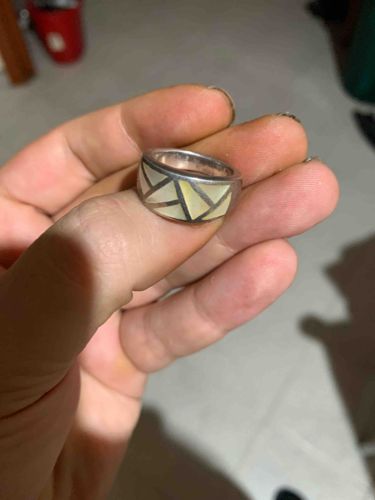
This item is a wide band ring, likely crafted from sterling silver based on its metallic sheen and typical use for such jewelry. The ring features a broad, uniform width around the entire circumference. Its most prominent characteristic is the intricate inlay work, consisting of numerous pieces of what appears to be mother-of-pearl or a similar shell material. These pieces are cut into various geometric shapes, predominantly triangles and irregular trapezoids, meticulously fitted together to form a continuous, mosaic-like pattern around the exterior surface of the band. The mother-of-pearl exhibits an iridescent quality, with creamy white to light yellow hues and subtle shifts in color depending on the angle of light, indicating its natural origin. The metallic dividers between these inlaid pieces are thin and well-defined, suggesting careful craftsmanship to hold the inlay in place and create the geometric design. There are no obvious maker's marks or signatures visible in the provided image, but such marks are typically found on the inside of the band. The ring appears to be in good overall condition, with no overt signs of significant damage, cracking in the inlay, or excessive tarnishing on the metal, though a light patina consistent with age and occasional wear is possible. The style of the inlay pattern, while difficult to pinpoint precisely without clearer detail, suggests a design aesthetic that could range from southwestern Native American (Zuni, Navajo) to certain Art Deco influences, or even contemporary artisan jewelry. The craftsmanship, particularly the precise fitting of the numerous small inlay pieces, indicates a certain level of skill. This type of ring is often associated with the mid-to-late 20th century or more modern periods.
AI Appraisal Report
Based on my visual examination of the provided image, this Inlaid Mother-of-Pearl Band Ring appears to be in good overall condition. The mother-of-pearl inlay shows good iridescence with creamy white to light yellow hues, and the pieces are meticulously fitted, indicating careful craftsmanship. I detect no obvious signs of significant damage, cracking in the inlay, or heavy tarnishing on the metal from the image. The continuous, mosaic-like pattern of geometric shapes is well-executed. As for authenticity, without physical inspection, I can only assess its visual characteristics. The style of inlay could be consistent with Southwestern Native American, Art Deco, or contemporary artisan work generally.
Market conditions for such inlaid mother-of-pearl rings vary significantly based on the quality of materials, the artist's reputation, and provenance. Similar sterling silver and mother-of-pearl inlay rings by unnamed artisans typically fetch between $75 and $150. If this piece were definitively identified as Zuni, Navajo, or by a well-known artisan, its value could be considerably higher. Demand for well-crafted artisan jewelry remains steady, though pieces without a specific identifiable maker or strong provenance are not considered particularly rare. The precise fitting of the inlay is the primary factor impacting its value positively, alongside its good apparent condition.
IMPORTANT LIMITATIONS: Authentication from an image alone is severely limited. To fully authenticate and determine a more precise value, a direct physical examination is crucial. This would allow me to confirm the metal composition (e.g., sterling silver vs. plated base metal), assess the quality and type of shell material definitively, search for any maker's marks or hallmarks, and evaluate the integrity of the inlay much more closely. Provenance documentation, such as purchase receipts or certificates of authenticity, would also be invaluable in confirming its origin and artist.