AI estimate as of June 29, 2025 · verify with a professional before acting
AI-Generated · Verify before acting
Everything on this page is generated by AI for informational purposes only. AI can make mistakes — the AI may misidentify items or misattribute them (artist, maker, brand, designer, origin, era). This is not an official valuation and should not be used for insurance, sale, tax, estate, legal, or lending purposes — or any decision requiring a certified appraisal. It is not an authoritative claim about any person, brand, or rights holder — do not share or rely on it as a factual statement about a third party. Always consult qualified professionals before making financial decisions.
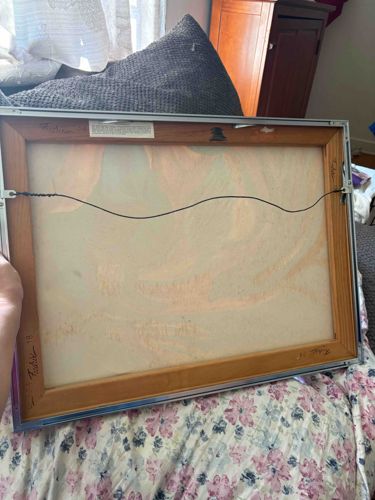
This item is the reverse side of a professionally framed piece of artwork, likely a painting or print, characterized by its sturdy construction and clear identifying marks. The outer frame is made of a silvery-grey metal, possibly aluminum, exhibiting a lean, contemporary profile designed for minimalist integration into a space. Inside this metal frame, the artwork is supported by a robust wooden stretcher frame, appearing to be crafted from light-toned wood, with visible butt joints at the corners that indicate solid assembly. A black, twisted metal picture hanging wire is securely attached to two metal D-rings or eyelets located on the upper-side stretcher bars, indicating readiness for wall display. The wire shows appropriate slack for hanging.
The backing of the artwork, presumably untouched canvas or a raw backing board, shows a light, off-white or cream coloration with subtle, widespread discoloration and minor surface dust, suggesting age or environmental exposure but no significant structural damage or egregious staining. Notable identifying features include handwritten notations in black ink or marker on the wooden stretcher bars. The name "Tarbush" is clearly inscribed on the top left section of the wooden frame, and vertically again on both the bottom left and bottom right corners, accompanied by the number "10". This repeated inscription strongly suggests the artist's signature, a series name, or title, with "10" potentially indicating the year of creation (e.g., 2010) or an edition number. A white rectangular label, though illegible in the provided image, is affixed to the top stretcher bar, likely containing further provenance, artist details, or framing instructions. The overall condition suggests minor wear consistent with its age and handling, primarily superficial dust and a mild, uniform patination on the exposed wood and backing material. The framing appears to be of good quality and professional construction, designed for durable presentation and display, indicative of craftsmanship suitable for gallery or collection pieces. The style of the frame and hanging mechanism points towards a relatively modern piece, likely from the late 20th or early 21st century.
AI Appraisal Report
Upon my examination of the provided image depicting the reverse side of this Framed Artwork, I note its professional construction and condition. The silvery-grey metal frame and robust wooden stretcher bars indicate a high-quality, durable presentation, likely from the late 20th or early 21st century. The overall condition is good, showing minor superficial dust and patination consistent with age and handling, with no apparent structural damage to the framing components.
Authenticity of the artwork itself is severely limited by only viewing the reverse. The handwritten inscription "Tarbush" and number "10" on the stretcher bars are intriguing, potentially indicating an artist's signature, series name, or an edition, providing a lead for provenance research. However, without direct access to the artwork's front, I cannot verify the artist, medium, subject, or intrinsic artistic quality. The illegible label further impedes specific attribution.
Market value for such an item is largely driven by the intrinsic quality, artist's reputation, and condition of the artwork itself, none of which can be assessed here. High-quality framing adds value (estimated $100-$300+ based on size), but is secondary to the art. Without identifying the artist ("Tarbush") and evaluating the artwork, it is relegated to the market segment of 'unattributed' or 'decorative' contemporary art. Demand and rarity are currently indeterminable.
For a comprehensive appraisal and full authentication, an in-person examination of the artwork's front is paramount to assess its medium, condition, artistic merit, and any visible signature. Crucially, I would need provenance documentation (e.g., purchase records, exhibition history) and comparative market research for works by "Tarbush" if they prove to be a recognized artist. Without these, any value assigned remains speculative.