AI Appraisal Estimate

AI-generated estimates · not official valuations

From the user

What was submitted

Photo and notes provided by the user — not generated by AI

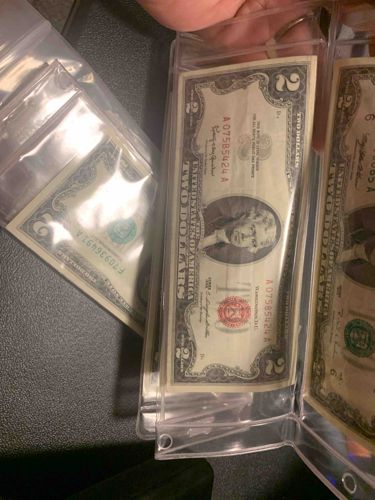
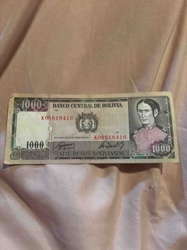
Submitted item photo
Submitted photo · June 17, 2026

User's notes

No additional notes provided.

AI analysis below

AI appraisal

AI analysis & estimate

AI-Generated · Verify before acting

Everything below is generated by AI for informational purposes only. AI can make mistakes — the AI may misidentify items or misattribute them (artist, maker, brand, designer, origin, era). This is not an official valuation and should not be used for insurance, sale, tax, estate, legal, or lending purposes — or any decision requiring a certified appraisal. It is not an authoritative claim about any person, brand, or rights holder — do not share or rely on it as a factual statement about a third party. Always consult qualified professionals before making financial decisions.

Read the full disclaimer

AI Identification

·Not independently authenticated·Verify before acting

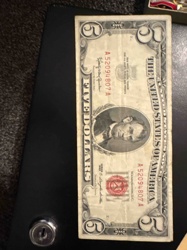
Series 1963 United States $2 Red Seal Legal Tender Note

Numismatics / Paper Currency

AI Estimated Value

·Not an official valuation·Verify before acting

$4.00 - $7.00

As of June 17, 2026

AI Item Analysis

·AI can make mistakes·Verify before acting
This is a Series 1963 Two Dollar United States Note, distinguished by its prominent red Treasury seal and red serial numbers. The obverse features the portrait of Thomas Jefferson, the third President of the United States. The bill is printed on standard fibrous currency paper with a mix of black and red ink. Notable markings include the serial number 'A 07585424 A' and the signatures of Kathryn O'Hay Granahan (Treasurer of the United States) and C. Douglas Dillon (Secretary of the Treasury). The note is housed in a clear protective plastic sleeve within a collector's album. Condition appears to be 'Circulated' with visible vertical and horizontal fold lines (creasing), though the paper remains largely crisp without significant staining or tearing. The red seal is located on the right side of the portrait, and the '2' numerals in the corners are clear. These red seal notes were discontinued in the mid-1960s, making them popular among numismatic collectors compared to the modern green seal Federal Reserve Notes. The craftsmanship shows the intricate intaglio printing common to U.S. Bureau of Engraving and Printing products of the mid-20th century.
AI Appraisal Report

·AI can make mistakes·Verify before acting
I have examined the digital representation of the Series 1963 $2 United States Legal Tender Note. Authenticity appears consistent with Bureau of Engraving and Printing standards of the period, specifically noting the characteristic red Treasury seal and serial numbers (A 07585424 A) and the correct signatures of Granahan and Dillon. The note exhibits 'Fine' to 'Very Fine' circulated condition, evidenced by prominent horizontal and vertical fold lines forming a 'cross' fold pattern. While the paper maintains decent body and the ink remains vibrant without significant environmental staining, the heavy creasing precludes a 'Crisp Uncirculated' grade. From a market perspective, the 1963 series is the most common of the modern red seal $2 notes. Unlike the earlier 1928 or 1953 series, the 1963 was produced in large quantities (approximately 40 million notes). Consequently, demand is driven primarily by 'type' collectors rather than rarity. While legal tender, these have largely exited circulation and carry a modest numismatic premium. In the current market, circulated examples generally realize between $4 and $7, whereas uncirculated specimens can reach $15-$20. Note that this appraisal is based on photographic evidence. A formal valuation requires physical inspection to verify paper texture, presence of pinholes, or evidence of 'washing' or 'pressing'—restoration techniques that can diminish value. To confirm absolute authenticity, I would examine the note under UV light to check for security fiber reactions and use a high-magnification loupe to verify the presence of raised intaglio ink ridges, which are difficult to replicate via modern digital printing.

Get your items appraised

Instant estimates of your treasures with AI-powered appraisals

Browse More Appraisals