These notes were written by the person who submitted this item. Appraiser.AI has not verified them, and the AI's identification and estimate may rely on them.
AI Estimated Value
Not an official valuation
$2-5
AI estimate as of August 3, 2025 · verify with a professional before acting
AI-Generated · Verify before acting
Everything on this page is generated by AI for informational purposes only. AI can make mistakes — the AI may misidentify items or misattribute them (artist, maker, brand, designer, origin, era). This is not an official valuation and should not be used for insurance, sale, tax, estate, legal, or lending purposes — or any decision requiring a certified appraisal. It is not an authoritative claim about any person, brand, or rights holder — do not share or rely on it as a factual statement about a third party. Always consult qualified professionals before making financial decisions.
This analysis also relies on unverified notes provided by the user, which may be incomplete or inaccurate and could affect the result.
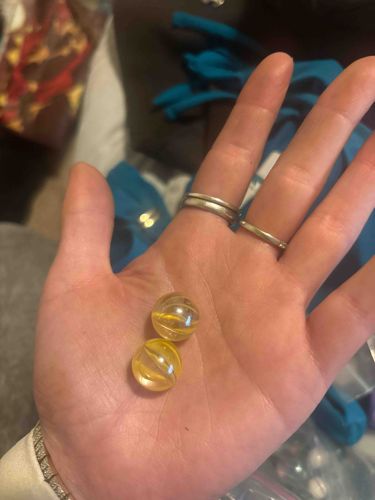
The image displays two clear glass marbles, each featuring a distinct internal swirl pattern. These marbles appear to be made of transparent glass with a slight yellowish or amber tint, allowing light to pass through them. Inside each marble, several strands or ribbons of what appears to be yellow or golden-colored glass are suspended, forming a characteristic swirled or banded design. The patterns within are not perfectly symmetrical but rather exhibit an organic, flowing quality, typical of machine-made marbles from the mid-20th century onwards. Each marble is spherical and appears to be approximately 1/2 to 3/4 inch in diameter, a common size for 'shooter' marbles or those used in general play. The surface of the marbles reflects light, indicating a smooth, polished finish, and there are no immediately visible chips, cracks, or significant abrasions, suggesting they are in good to very good condition. Slight surface wear, such as minor scratches, might be present but is not clearly discernible from the image. The manufacturing method likely involves an automated process where molten glass is cut and rolled to form spheres, after which colored glass threads are introduced and swirled before the glass cools and hardens. While specific maker's marks are not present on marbles of this type, the consistent clear glass body with internal colored swirls points towards a mass-produced item. These marbles are likely from the mid to late 20th century.
AI Appraisal Report
Upon examining the image of these two clear glass marbles with yellow swirls, their condition appears to be good to very good. The smooth, polished surface suggests minimal wear, and I observe no significant chips, cracks, or deep abrasions. Without a physical inspection, however, I cannot definitively rule out minor surface scratches or fleabites that are common with play-worn marbles. Authenticity-wise, these appear to be typical machine-made marbles, likely dating from the mid to late 20th century, consistent with the described manufacturing process of clear glass bodies with internal swirled colored threads. These patterns, while unique to each marble, are hallmarks of mass-produced items rather than highly collectible artisan examples.
Market conditions for common machine-made marbles like these are generally stable but with relatively low value. Comparables for such marbles, even in good condition, typically range from under a dollar to a few dollars per marble, largely dependent on the specific design and condition. These particular marbles do not exhibit any highly sought-after characteristics such as rare glass colors, unusual patterns, or maker's marks that would significantly elevate their value. Demand for common play marbles is modest, primarily from collectors establishing basic sets or individuals seeking nostalgic items. They are not considered rare.
Factors significantly impacting value here are primarily their condition and lack of extraordinary features. If, upon in-person examination, hidden damages were found, the value would decrease. Conversely, if these somehow proved to be a rare variant or early production examples, their value could slightly increase, but this is highly unlikely for this type. For full authentication and to ascertain any hidden flaws, physical inspection, including magnification and handling, is essential. Provenance documentation, while not usually available or necessary for common marbles, would further confirm their origin if it were a rare or significant piece. Scientific testing is generally not applied to items of this nature given their typical market value.