These notes were written by the person who submitted this item. Appraiser.AI has not verified them, and the AI's identification and estimate may rely on them.
AI Estimated Value
Not an official valuation
$20-50
AI estimate as of November 1, 2025 · verify with a professional before acting
AI-Generated · Verify before acting
Everything on this page is generated by AI for informational purposes only. AI can make mistakes — the AI may misidentify items or misattribute them (artist, maker, brand, designer, origin, era). This is not an official valuation and should not be used for insurance, sale, tax, estate, legal, or lending purposes — or any decision requiring a certified appraisal. It is not an authoritative claim about any person, brand, or rights holder — do not share or rely on it as a factual statement about a third party. Always consult qualified professionals before making financial decisions.
This analysis also relies on unverified notes provided by the user, which may be incomplete or inaccurate and could affect the result.
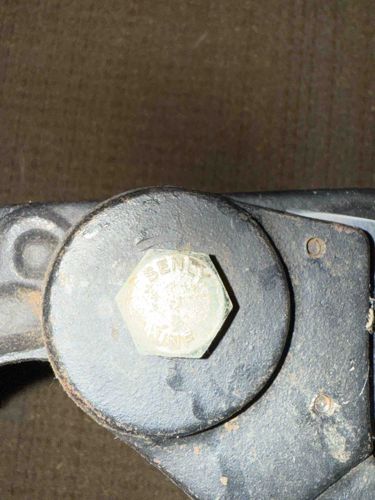
The image displays a close-up detail of what is identified as a Brot-max German bread slicer, specifically focusing on a hexagonal bolt or fastener and surrounding mechanical components. The primary material visible appears to be cast iron or a similar heavy-duty metal, characterized by a dark, possibly charcoal grey or black, rough textured finish, which suggests a durable, utilitarian construction. The visible surfaces show signs of wear and age, including areas where the paint or finish has chipped, revealing rust or a lighter colored base metal underneath. There are also deposits of dust, grime, and possibly flour or food residue, consistent with kitchen use. A prominent hexagonal bolt, likely made of galvanized steel or a similar light-colored metal alloy, is centrally located. It has a slightly dulled, aged metallic sheen and is inscribed with the word "SENF" or "SENS" (the second letter is somewhat obscured but could be 'E' or 'L') along with other faint, illegible markings, possibly indicating a manufacturer or a part number. This bolt secures a circular metal plate or washer against a larger, dark-colored component, typical of an adjustable or rotating mechanism on a slicer. The overall aesthetic points to an older, robust appliance from a style period that prioritized functionality and durability over sleek modern design, likely from the mid-20th century.
AI Appraisal Report
Based on my visual examination of the provided image, this detail shot appears to be a functional, albeit aged, component of a Brot-max German bread slicer. The heavy-duty cast iron construction and visible wear, including chipped paint, rust, and residues, are consistent with an older appliance that has seen regular use. The hexagonal bolt, possibly galvanized steel, shows age but seems structurally sound. The inscription 'SENF' or 'SENS' on the bolt is a curious detail that might indicate a part supplier or a batch number, but its exact meaning is unclear without further research. This component clearly belongs to a vintage, utilitarian bread slicer, likely from the mid-20th century, valuing durability over modern aesthetics.
Market conditions for vintage bread slicer *parts* are generally low unless the part is critical, rare, and enables the restoration of a high-value complete unit. While Brot-max slicers are appreciated for their robustness by collectors of vintage kitchenware, individual components, especially those with visible wear, typically hold limited value unless they are the sole missing piece for a highly sought-after complete slicer. Demand for such specific parts is niche, and rarity is hard to determine without knowing the broader components of the slicer to which this attaches. Factors impacting current value are its condition (showing significant wear and grime) and its nature as a single part rather than a complete item.
Limitations for full authentication are significant. From an image alone, I cannot definitively confirm the material composition, original finish, or the precise model compatibility. An in-person examination would allow me to assess structural integrity, measure dimensions, analyze the rust deeper, and ascertain if the 'SENF' inscription is an authentic factory mark or a later addition. Provenance documentation (e.g., original manuals, sales receipts) would be crucial to verify the part's origin and period. Without these, the appraisal remains an estimate for a used, vintage appliance part.