AI estimate as of August 26, 2025 · verify with a professional before acting
AI-Generated · Verify before acting
Everything on this page is generated by AI for informational purposes only. AI can make mistakes — the AI may misidentify items or misattribute them (artist, maker, brand, designer, origin, era). This is not an official valuation and should not be used for insurance, sale, tax, estate, legal, or lending purposes — or any decision requiring a certified appraisal. It is not an authoritative claim about any person, brand, or rights holder — do not share or rely on it as a factual statement about a third party. Always consult qualified professionals before making financial decisions.
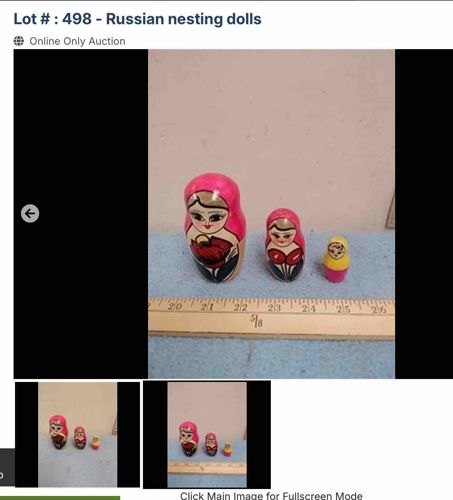
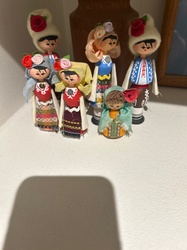
This lot consists of three Russian nesting dolls, also known as Matryoshka dolls, displaying a sequential size reduction. The dolls appear to be crafted from wood, a traditional material for these items, and are hand-painted with vibrant colors. The largest doll, likely the 'mother' doll, features a bright pink headscarf and a traditional Russian dress in shades of red, black, and blue, with notable white accents. Her facial features are delicately painted with large eyes and a calm expression. She is depicted holding what appears to be a floral or decorative pattern on her chest. The second largest doll maintains the pink headscarf theme but features a more ornate bodice, possibly depicting a bustier or stylized garment, in red and black, again with white detailing. The smallest doll is distinctively Yellow with a pink base and simpler, possibly stylized, facial features and a minimal design, suggesting it is the innermost doll. A ruler placed alongside the dolls indicates the largest doll is approximately 5-6 inches tall, and the entire set, when placed side-by-side, spans about 6 inches. The craftsmanship appears to be folk art quality, with hand-painting evident in the slight variations and brushstrokes. There are no obvious signs of significant damage like cracks or chips visible from the provided images, though detailed wear and tear on the paint or wood cannot be fully assessed without closer inspection. The glossy finish suggests a protective lacquer layer, common for these dolls. The design style suggests a traditional Russian aesthetic, likely from the late 20th or early 21st century. No discernible maker's marks or signatures are visible in the provided image.
AI Appraisal Report
I have examined the provided image of this set of three Russian nesting dolls. Based on my visual assessment, the dolls appear to be in good overall condition, showing no apparent cracks, chips, or significant paint loss. The hand-painted folk art quality is evident in the vibrant colors and traditional Russian motifs. The glossy finish suggests a protective lacquer, which is common for these items and helps preserve the paintwork.
Authenticity: These appear to be genuine, traditional Russian Matryoshka dolls. However, without in-person inspection, it's impossible to confirm the wood type or the exact painting techniques used. There are no visible maker's marks or signatures, which is common for folk art but limits specific attribution. Full authentication would require physical examination to assess joinery, material quality, and potential artist signatures often hidden inside.
Market Conditions & Comparables: The market for traditional Russian nesting dolls is stable, with demand largely driven by tourism and collectors of folk art. Sets of three, particularly those of this size (largest doll 5-6 inches), are common. Comparable contemporary hand-painted sets of this size typically retail between $30 and $70. The lack of extreme rarity, significant age, or a renowned artist keeps the value in the accessible range.
Demand & Rarity: These dolls are not particularly rare; mass production and widespread availability mitigate high demand for average examples. Their appeal lies in their decorative nature and cultural significance rather than investment potential.
Factors Impacting Value: The hand-painted quality positively impacts value over machine-printed items. However, the relatively small size and common three-doll configuration, along with the lack of exceptional artistic detail or historical provenance, keep the value modest. Any significant damage, such as cracks, chips, or major paint wear, would reduce this value. Conversely, an artist's signature, documented historical significance, or exceptionally intricate details could increase it significantly.
Limitations: My assessment is based solely on the provided image. A physical examination would allow for closer inspection of paint integrity, wood condition, internal craftsmanship, and definitive identification of any hidden marks or signatures. Provenance documents, if available, would further enhance authentication and potentially value.